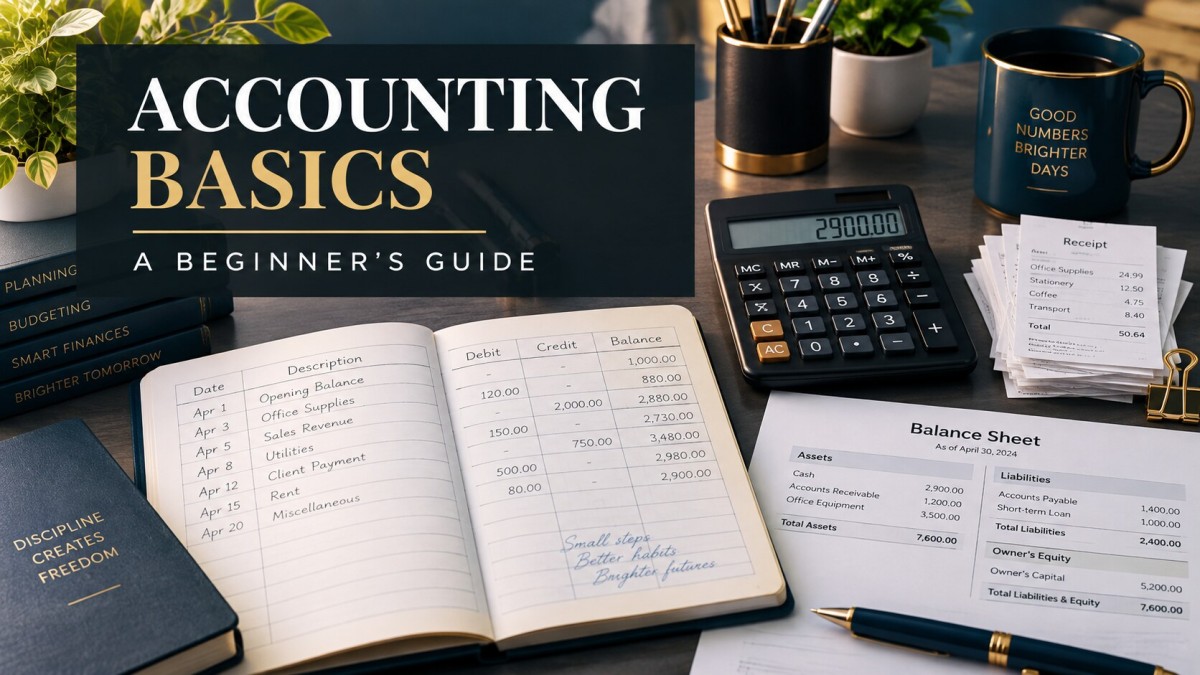

Accounting for Beginners: Meaning, Types and Importance

Learn what accounting is, why it is important and how businesses record, organise and understand financial transactions. This beginner-friendly guide explains accounting principles, types, financial statements and the basic accounting process.

Sep 09, 2026 - 21:42
0 0
Accounting for Beginners: Meaning, Types and Importance

Accounting for Beginners: Meaning, Types and Importance

Every business deals with money. It receives payments from customers, purchases products, pays employees, manages expenses and invests in future growth. Without a proper system for recording these transactions, it becomes difficult to understand whether the business is earning a profit or losing money.

That is where accounting becomes important.

Accounting helps individuals and businesses record, organise and understand their financial activities. It provides a clear picture of where money is coming from, where it is being spent and how much the business owns or owes.

This beginner-friendly guide explains the meaning of accounting, its importance, major types, basic principles and the financial statements every business owner should understand.

What Is Accounting?

Accounting is the process of recording, classifying, summarising and analysing financial transactions.

In simple words, it is a system used to track the financial activities of a person or business.

Whenever a business makes a sale, purchases stock, pays rent, receives a loan or pays an employee, that transaction should be recorded. These records are later used to prepare financial statements and understand the financial condition of the business.

Accounting answers important questions such as:

  • How much money did the business earn?

  • What were its total expenses?

  • Is the business making a profit or loss?

  • How much money does the business owe?

  • How much money do customers owe the business?

  • Does the business have enough cash to pay its bills?

  • What is the overall financial value of the business?

Reliable accounting information helps business owners make decisions based on facts instead of assumptions.

Accounting and Bookkeeping: Are They the Same?

Accounting and bookkeeping are closely connected, but they are not exactly the same.

What Is Bookkeeping?

Bookkeeping is the process of recording daily financial transactions. It includes recording sales, purchases, receipts, payments and expenses.

For example, when a shop owner sells a product for ₹5,000, the sale should be entered into the business records. This daily recording is part of bookkeeping.

What Is Accounting?

Accounting goes beyond recording transactions. It involves checking, classifying, summarising and analysing the recorded information.

An accountant may use bookkeeping records to prepare financial statements, measure profitability, study cash flow and support business decisions.

In short:

  • Bookkeeping records financial transactions.

  • Accounting explains what those transactions mean for the business.

Both are necessary for maintaining accurate financial records.

Why Is Accounting Important?

Accounting is not limited to large companies. It is equally important for freelancers, shopkeepers, startups and small-business owners.

1. It Tracks Income and Expenses

Accounting records how much money a business earns and spends. This helps the owner understand whether expenses are under control.

2. It Measures Profitability

High sales do not always mean high profit. A business may generate strong revenue but still lose money because of excessive expenses.

Accounting helps calculate the actual profit remaining after deducting business costs.

3. It Supports Better Decisions

Accurate financial information helps business owners decide whether they should:

  • Reduce unnecessary expenses

  • Increase prices

  • Purchase more inventory

  • Hire employees

  • Open another branch

  • Invest in new equipment

4. It Improves Cash-Flow Management

A profitable business can still face financial difficulty if it does not have enough cash available to make payments.

Accounting helps track incoming and outgoing cash, making it easier to plan rent, salaries, supplier payments and other expenses.

5. It Helps With Tax and Compliance

Proper financial records make it easier to calculate taxable income, prepare returns and provide supporting documents when required.

6. It Builds Trust

Banks, investors and lenders may examine a business’s financial statements before providing funding. Accurate records make the business appear more organised and trustworthy.

7. It Identifies Financial Problems

Regular accounting may reveal increasing expenses, declining profit margins, unpaid customer invoices or unnecessary borrowing before these problems become serious.

Main Types of Accounting

Different forms of accounting are used for different purposes.

Financial Accounting

Financial accounting records business transactions and prepares financial statements for a specific period.

It helps business owners and external stakeholders understand the company’s financial performance and position.

Management Accounting

Management accounting provides financial information to business managers for internal decision-making.

It may include:

  • Department-wise expenses

  • Product profitability

  • Sales forecasts

  • Budget comparisons

  • Cost analysis

Unlike financial accounting, management accounting is mainly designed for internal use.

Cost Accounting

Cost accounting measures the cost of producing a product or providing a service.

It helps a business calculate expenses related to raw materials, labour, manufacturing and operations. This information can be used to set prices and control production costs.

Tax Accounting

Tax accounting focuses on financial records required for calculating taxes and preparing tax returns.

It helps individuals and businesses organise their income, expenses, deductions and other tax-related information.

Auditing

Auditing is the examination of financial records to check whether they are accurate, complete and prepared according to applicable standards.

Internal audits help management improve controls, while external audits provide an independent review of financial statements.

Basic Accounting Terms You Should Know

Understanding a few basic terms makes accounting easier.

Assets

Assets are resources owned or controlled by a business that provide financial value.

Examples include:

  • Cash

  • Inventory

  • Machinery

  • Computers

  • Furniture

  • Vehicles

  • Money receivable from customers

Liabilities

Liabilities are amounts that a business owes to other people or organisations.

Examples include:

  • Bank loans

  • Supplier payments

  • Unpaid bills

  • Employee salaries payable

  • Taxes payable

Owner’s Equity

Owner’s equity is the owner’s financial interest in the business after liabilities are deducted from assets.

It generally represents the amount invested by the owner plus accumulated profits, minus withdrawals and losses.

Revenue

Revenue is the income generated from the normal activities of a business, such as selling products or providing services.

Expenses

Expenses are the costs incurred to operate a business.

Common expenses include rent, salaries, electricity, advertising, transportation and office supplies.

Profit

Profit is the amount remaining after total expenses are deducted from total revenue.

Profit = Revenue − Expenses

Loss

A loss occurs when total expenses are greater than total revenue.

Accounts Receivable

Accounts receivable represents money that customers still have to pay to the business.

Accounts Payable

Accounts payable represents money that the business needs to pay to suppliers or other parties.

Understanding the Accounting Equation

The basic accounting equation is:

Assets = Liabilities + Owner’s Equity

This equation shows how a business’s assets are financed.

For example, suppose a person starts a business by investing ₹2,00,000 and also takes a bank loan of ₹1,00,000.

The business now has:

  • Assets worth ₹3,00,000

  • Liabilities of ₹1,00,000

  • Owner’s equity of ₹2,00,000

Therefore:

₹3,00,000 = ₹1,00,000 + ₹2,00,000

Every correctly recorded transaction should keep this equation balanced.

What Is Double-Entry Accounting?

In the double-entry accounting system, every transaction affects at least two accounts.

For example, if a business purchases a computer using cash:

  • The computer or equipment account increases.

  • The cash account decreases.

The total financial value remains balanced even though the type of asset changes.

Double-entry accounting improves accuracy and helps businesses identify recording mistakes.

Important Financial Statements

Financial statements convert accounting records into useful business information.

1. Income Statement

The income statement, also called the profit and loss statement, shows revenue, expenses and profit or loss during a particular period.

A basic income statement follows this structure:

Revenue − Expenses = Profit or Loss

It helps business owners understand whether their operations are financially successful.

2. Balance Sheet

The balance sheet shows the financial position of a business on a particular date.

It contains three main sections:

  • Assets

  • Liabilities

  • Owner’s equity

While the income statement measures performance over a period, the balance sheet provides a snapshot of what the business owns and owes at a specific moment.

3. Cash-Flow Statement

The cash-flow statement tracks how cash enters and leaves the business.

Cash flow is generally divided into:

  • Operating activities

  • Investing activities

  • Financing activities

This statement is important because profit and available cash are not always the same.

For example, a business may record a sale as revenue but may not receive the payment immediately. It can therefore show a profit while still experiencing a cash shortage.

The Basic Accounting Process

The accounting process usually follows these steps:

Step 1: Identify Financial Transactions

The business first identifies activities that have a financial impact, such as sales, purchases, payments, loans and investments.

Step 2: Collect Supporting Documents

Every transaction should have supporting evidence whenever possible.

Documents may include:

  • Sales invoices

  • Purchase bills

  • Bank statements

  • Payment receipts

  • Expense vouchers

  • Salary records

  • Loan documents

Step 3: Record Transactions

Transactions are entered into journals, accounting registers or accounting software.

Each entry should include the date, amount, account affected and a short description.

Step 4: Classify Transactions

Recorded transactions are organised into suitable categories such as sales, rent, salaries, inventory, advertising and transportation.

Step 5: Reconcile Records

The business compares its accounting records with bank statements, invoices and receipts to find missing or incorrect entries.

Step 6: Make Adjustments

Necessary adjustments may be recorded for unpaid expenses, advance payments, depreciation or income that has been earned but not yet received.

Step 7: Prepare Financial Statements

The final balances are used to prepare the income statement, balance sheet and cash-flow statement.

Step 8: Review the Results

The owner or accountant analyses the statements to understand profitability, financial stability, cash availability and areas requiring improvement.

Manual Accounting vs Accounting Software

Small businesses may maintain records manually or use accounting software.

Manual Accounting

Manual accounting uses notebooks, registers or spreadsheets.

It may be suitable for a very small business with limited transactions, but it can become difficult to manage as the business grows.

Common risks include:

  • Calculation errors

  • Duplicate entries

  • Missing records

  • Difficult reconciliation

  • Time-consuming report preparation

Accounting Software

Accounting software helps automate transaction recording, invoice management, expense tracking and financial reporting.

Depending on the software, it may also provide:

  • Inventory tracking

  • Customer and supplier records

  • Bank reconciliation

  • Payment reminders

  • Profit-and-loss reports

  • Tax-related reports

  • Data backup

Software can save time, but the information entered must still be accurate. Automation cannot correct incorrect or incomplete source data.

Cash Accounting and Accrual Accounting

Businesses may record transactions using the cash or accrual method.

Cash Accounting

Under cash accounting, income is recorded when money is received and expenses are recorded when money is paid.

It is relatively simple and helps track actual cash movement.

Accrual Accounting

Under accrual accounting, income is recorded when it is earned and expenses are recorded when they are incurred, even if payment happens later.

For example, if a business delivers a service in March but receives payment in April, accrual accounting generally records the income in March.

The appropriate accounting method may depend on the nature, size and reporting requirements of the business.

Common Accounting Mistakes

Beginners should avoid these common mistakes:

Mixing Personal and Business Money

Using the same account for personal and business transactions makes it difficult to measure actual business performance.

Failing to Record Small Expenses

Small expenses may appear unimportant, but they can become a significant amount over time.

Ignoring Unpaid Invoices

A sale does not provide usable cash until the customer makes the payment. Businesses should regularly monitor outstanding invoices.

Not Reconciling Bank Accounts

Without reconciliation, missing payments, duplicate entries or bank charges may remain unnoticed.

Losing Bills and Receipts

Missing supporting documents may create problems during financial review or tax preparation.

Delaying Entries

Waiting until the end of the month or year to record transactions increases the chance of mistakes.

Treating Revenue as Profit

Revenue is the total income from sales. Profit is what remains after deducting expenses. Confusing the two can lead to poor financial decisions.

Not Taking Regular Backups

Digital accounting records should be backed up securely to reduce the risk of data loss.

Simple Accounting Tips for Small Businesses

A small business can improve its accounting system by following a few practical habits:

  1. Keep personal and business transactions separate.

  2. Record income and expenses regularly.

  3. Store invoices and receipts in an organised manner.

  4. Use clear and consistent expense categories.

  5. Reconcile bank records every month.

  6. Monitor customer payments and supplier dues.

  7. Review profit, expenses and cash flow regularly.

  8. Back up digital records securely.

  9. Restrict access to sensitive financial information.

  10. Consult a qualified professional when necessary.

When Should You Hire an Accountant?

A business may consider professional accounting support when:

  • The number of transactions increases

  • Records become difficult to manage

  • The business hires employees

  • Inventory becomes more complex

  • The business applies for a loan

  • Financial reports are required

  • Tax and compliance responsibilities increase

  • The owner cannot confidently understand the accounts

An accountant does more than enter data. A reliable professional can help improve recordkeeping, explain financial results and identify potential problems.

Frequently Asked Questions

Is accounting necessary for a small business?

Yes. Even a small business needs accurate records to track income, expenses, customer dues, supplier payments, profit and cash flow.

Can I manage accounting myself?

A small business with simple transactions may manage basic records independently. However, professional support can be useful when transactions or compliance requirements become complicated.

What is the difference between revenue and profit?

Revenue is the total income earned from sales or services. Profit is the amount remaining after expenses are deducted from revenue.

How often should accounting records be updated?

Transactions should ideally be recorded regularly. Daily or weekly updates are usually easier and more reliable than waiting until the end of the month.

Does accounting software replace an accountant?

Accounting software automates several tasks, but it does not replace professional judgement. A business may still need an accountant for review, financial interpretation and complex matters.

Conclusion

Accounting is the financial foundation of a business. It records what the business earns, spends, owns and owes.

A reliable accounting system helps business owners understand profitability, manage cash flow, control expenses and make better decisions. The process may appear technical at first, but it becomes easier once the basic terms, accounting equation and financial statements are understood.

The most important step is to maintain complete, accurate and timely records. Whether a business uses a notebook, spreadsheet or accounting software, organised financial information can protect it from confusion and support sustainable growth.

Disclaimer: This article is for general educational purposes and should not be considered professional accounting, tax or legal advice. Rules may vary according to the business type and applicable regulations.

What's Your Reaction?

Like Like 0
Dislike Dislike 0
Love Love 0
Funny Funny 0
Wow Wow 0
Sad Sad 0
Angry Angry 0

Comments (0)

User