

How Generative AI Works: LLMs, Prompts and Hallucinations Explained
A clear beginner guide to generative AI, large language models, tokens, prompts, context windows, hallucinations and safe verification.
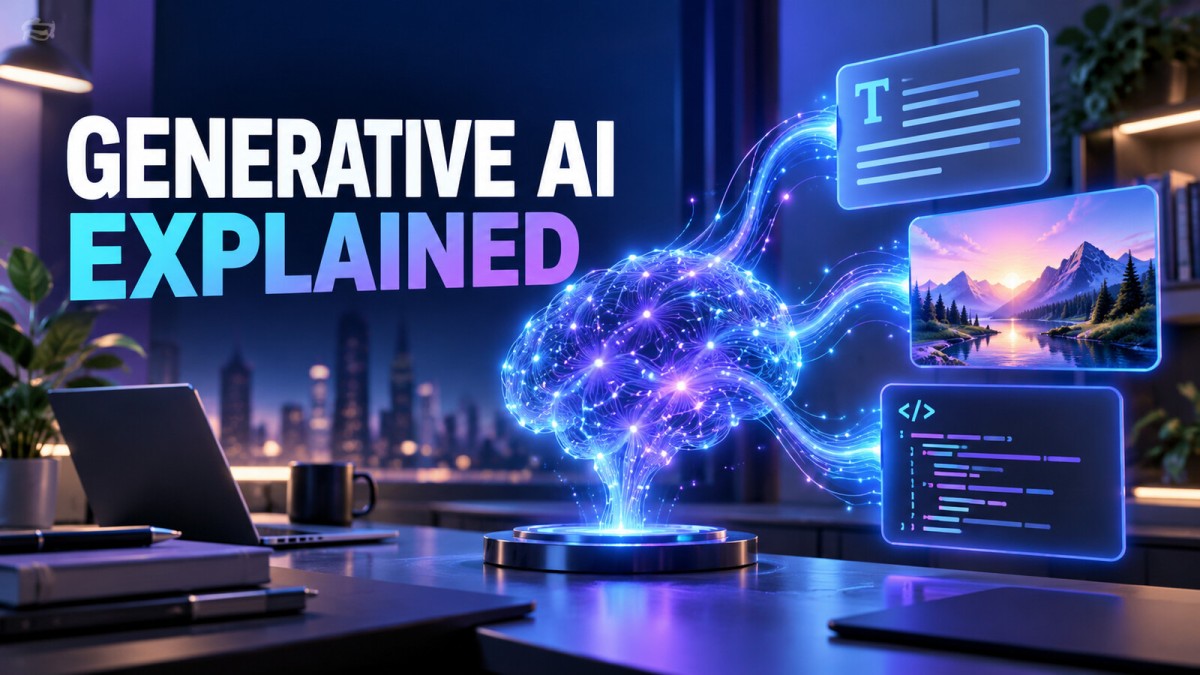
Generative AI can write paragraphs, create images, suggest code, summarise documents and answer questions in seconds. The speed is impressive, but the system is not “thinking” in the same way a person does. It predicts a useful output from patterns learned during training. Understanding that basic idea helps you use AI more effectively and recognise when an answer may be wrong.
This beginner-friendly guide explains large language models, prompts, tokens, context windows, hallucinations and responsible use without requiring a technical background.
What Is Generative AI?
Generative AI is a category of artificial intelligence designed to create new content. Depending on the model, that content may be text, images, audio, video, computer code or a combination of formats. A traditional software program follows rules written for a specific task. A generative model learns statistical patterns from large collections of examples and uses those patterns to produce a new result.
The output can look confident and polished even when it contains an error. Fluency is therefore not proof of accuracy.
What Is a Large Language Model?
A large language model, commonly called an LLM, is trained to work with sequences of language. During training, it learns relationships between words, phrases, topics and structures from many examples. When a user provides a prompt, the model estimates which token is likely to come next, then continues that process to build a response.
This simple description leaves out significant engineering detail, but it explains an important behaviour: an LLM produces a likely continuation rather than retrieving a guaranteed fact from a perfect database.
Tokens: The Small Pieces a Model Reads
AI systems usually process text as tokens. A token may be a complete word, part of a word, punctuation or another small unit. The exact tokenisation depends on the model and language. A short sentence can become several tokens, and the same idea may require different token counts in English, Hindi or another language.
Token limits matter because both your input and the generated answer use the model’s available context. Long documents may need to be divided into sections, summarised or processed through a retrieval system.
What Is a Context Window?
The context window is the amount of information a model can consider during one interaction. It may include your current prompt, previous messages, attached text and the model’s response. When the context becomes crowded, older or less relevant details may receive less attention.
For reliable work, keep the instructions organised. Put important facts close to the task, remove unrelated conversation and repeat critical constraints when necessary. A larger context window does not automatically guarantee better reasoning or perfect memory.
How a Prompt Changes the Result
A prompt is the instruction and supporting information given to the model. Strong prompts reduce ambiguity. They do not magically eliminate errors, but they make the expected result easier to understand.
A practical prompt usually contains:
- Task: What should be created or analysed?
- Audience: Who will read or use the answer?
- Source material: Which facts or documents should be used?
- Constraints: Length, tone, exclusions and compliance rules.
- Output format: Paragraphs, table, checklist, JSON or code.
- Uncertainty rule: What should happen if information is missing?
For example: “Summarise the policy below for a first-time customer in five bullet points. Use only the supplied text. Preserve every date and amount. If a detail is unclear, label it ‘Needs confirmation.’”
What Is an AI Hallucination?
A hallucination is an output that appears plausible but is unsupported, incorrect or fabricated. The model may invent a source, mix two people, produce the wrong date, misread a table or create code that looks valid but fails in practice.
Hallucinations happen because the model is optimised to generate a coherent response, not because it has malicious intent. They are more likely when a prompt asks for obscure facts, unavailable documents, future events, exact quotations or certainty where the model lacks reliable evidence.
How to Reduce Hallucination Risk
- Provide the source text instead of asking the model to remember it.
- Ask the system to separate facts, assumptions and suggestions.
- Require citations, then open and verify every cited source.
- Check important numbers with a calculator or original spreadsheet.
- Test generated code in a safe development environment.
- Ask for missing information to be marked rather than guessed.
- Use retrieval or an approved knowledge base for company-specific answers.
- Keep a human reviewer for legal, medical, financial and high-impact decisions.
Asking the same question twice is not a substitute for verification. Two confident answers can still repeat the same mistake.
Training, Fine-Tuning and Retrieval Are Different
Training builds the general model from a large dataset. Fine-tuning further adjusts a model using specialised examples so that it follows a desired style or task pattern. Retrieval-augmented generation, often shortened to RAG, searches an approved collection of documents and gives relevant passages to the model while it answers.
For many organisations, retrieval is useful because documents can be updated without retraining the entire model. However, poor search results, outdated files and weak access controls can still cause bad answers.
Why AI Answers Can Change
Generative systems may use controlled randomness so that they do not produce identical wording every time. Providers also update models, safety systems and product features. As a result, a prompt that worked earlier may produce a slightly different response later.
Businesses should save approved prompts, record model or product versions when possible and test important workflows after major updates.
Privacy and Security Basics
Before entering data into an AI service, ask whether that information is public, confidential or legally protected. Avoid sharing passwords, authentication codes, private keys, complete customer records, unpublished financial information and personal identifiers unless the organisation has approved the service and configured it correctly.
Prompt injection is another risk. A document or webpage can contain hidden or misleading instructions that try to make an AI assistant ignore the real task. Treat external content as untrusted and restrict what connected AI systems are allowed to access or change.
A Safe Verification Workflow
- Create a clear prompt using verified source material.
- Review the first output for missing assumptions.
- Check every important fact against the original source.
- Test calculations, links and code independently.
- Edit the response for clarity, context and human tone.
- Record approval when the output affects customers or operations.
Final Takeaway
Generative AI is a powerful prediction and creation technology, not an automatic truth machine. Better prompts, reliable source material and human verification make it far more useful. The safest mindset is simple: use AI for speed and exploration, but keep responsibility for accuracy with people.
Further Reading
Disclaimer: This article provides general educational information. AI products and capabilities change over time, so verify current documentation before using a system for important decisions.
What's Your Reaction?
 Like
0
Like
0
 Dislike
0
Dislike
0
 Love
0
Love
0
 Funny
0
Funny
0
 Wow
0
Wow
0
 Sad
0
Sad
0
 Angry
0
Angry
0

Software developer with expertise in full-stack web development and financial market analysis, specializing in building tracking tools for trading metrics.








Comments (0)