

The Power of Compounding: Formula, Examples and a Practical Guide
Understand compound interest with formulas, realistic rupee examples and practical guidance on time, returns, inflation, fees, regular contributions and debt.
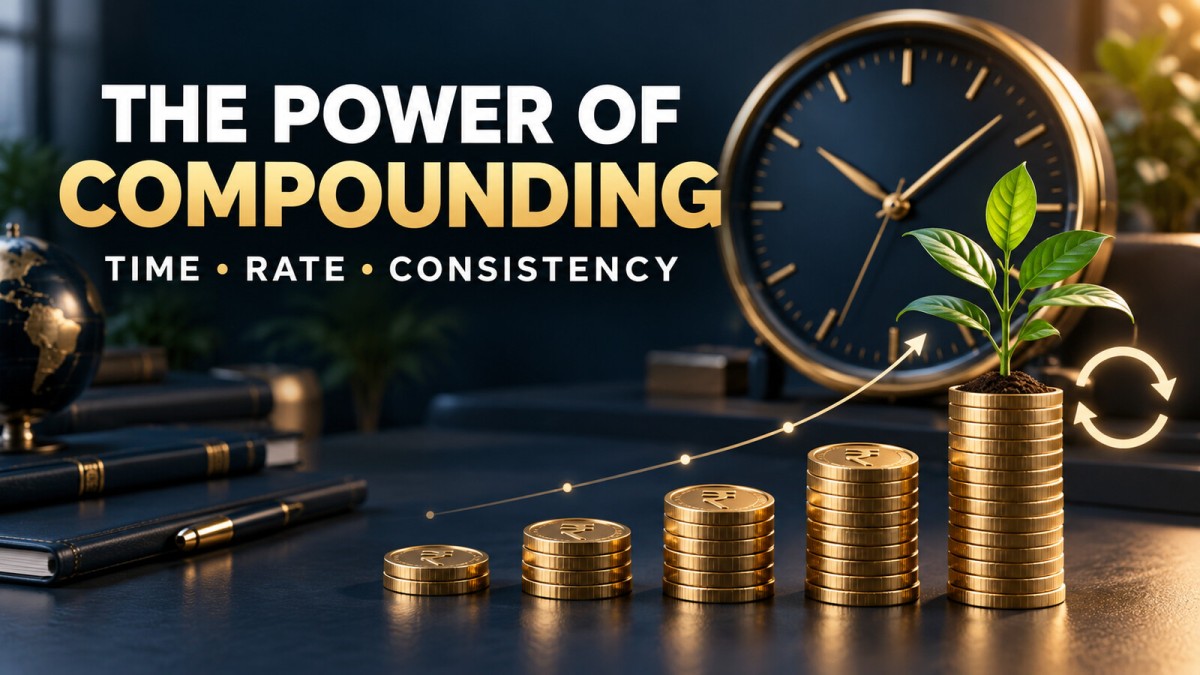
Compounding means earning a return not only on the original amount but also on returns that remain invested. Over time, this creates a growing base on which future gains may be calculated. The idea is simple, but its real effect depends on time, the actual rate of return, costs, taxes, inflation and whether the investor remains consistent.
Compounding is not magic and it does not guarantee wealth. A mathematical projection may show smooth growth, while real investments can rise, fall or produce uneven returns. This guide explains the calculation, realistic examples and the habits that allow compounding to work.
What Is Compound Interest?
With simple interest, interest is calculated only on the original principal. With compound interest, previously earned interest is added to the base, so future interest can be earned on both the principal and accumulated interest.
For an investment with a fixed rate and regular compounding, the standard formula is:
A = P(1 + r/n)nt
- A = future amount
- P = original principal
- r = annual rate written as a decimal
- n = number of compounding periods per year
- t = number of years
This formula is exact only when its assumptions apply. Market-linked investments do not normally deliver one fixed return every year, so their projections are estimates rather than promises.
Simple Interest vs Compound Interest: An Example
Suppose ₹1,00,000 earns a hypothetical 8% annually for ten years, with no tax, fees or withdrawals.
- Under simple interest, annual interest remains ₹8,000. After ten years, the total would be ₹1,80,000.
- With annual compounding, the projected amount would be approximately ₹2,15,892.
The difference arises because each year’s return remains in the account and joins the principal. This is an illustration of mathematics, not an expected return for any specific product.
The Four Main Drivers of Compounding
1. Time
Compounding tends to appear slow at first because the accumulated return is small. In later years, the return is calculated on a larger base. This is why beginning earlier can reduce the monthly contribution required for a distant goal.
Starting early helps, but starting late does not make planning useless. A later starter can still improve the outcome by saving more, extending the timeline where possible, controlling costs and choosing a suitable allocation.
2. Rate of Return
A higher rate produces a larger projection, but higher expected returns usually involve greater uncertainty or risk. Do not choose an investment only because a calculator looks attractive at an optimistic rate.
Use conservative assumptions, test several scenarios and understand whether the rate is guaranteed, declared, market-linked or merely based on historical data.
3. Regular Contributions
Adding money consistently grows the base available to compound. For many households, regular contributions from income matter more than trying to identify the perfect market date.
A Systematic Investment Plan (SIP) automates contributions to a mutual fund, but a SIP does not itself pay compound interest. The value of the fund units changes with the portfolio. “Compounding” in this context describes how reinvested gains and ongoing contributions may build value over time.
4. Reinvestment
Interest, dividends or other distributions must remain invested for full compounding. Taking the return out for spending reduces the amount available for future growth. Reinvestment may involve product rules, tax and market risk, so it should be understood rather than assumed.
Why Early Years Can Feel Unimpressive
Consider the same hypothetical ₹1,00,000 earning 8% annually:
| End of year | Illustrative amount | Growth during that year |
|---|---|---|
| 1 | ₹1,08,000 | ₹8,000 |
| 5 | About ₹1,46,933 | About ₹10,884 during year five |
| 10 | About ₹2,15,892 | About ₹15,992 during year ten |
The annual growth becomes larger because the base has grown. Real market returns will not follow this smooth pattern, and a portfolio may be lower in some years.
Compounding with Monthly Contributions
When money is added monthly, each instalment has a different holding period. The first contribution may compound for many years, while the final contribution may have only one month.
The future-value formula for equal end-of-month contributions is:
FV = PMT × [((1 + i)m − 1) / i]
- PMT = contribution per period
- i = assumed return per period
- m = number of contributions
For market-linked assets, a smooth monthly rate is only a planning assumption. Actual returns arrive unevenly, and the final result may be higher or lower.
Compounding Frequency Matters—but Usually Less Than Advertised
Interest may be compounded annually, quarterly, monthly or at another frequency. If the stated annual rate is the same, more frequent compounding generally results in a slightly higher effective annual amount.
However, investors should compare the effective yield, risk, liquidity, tax and fees—not select a product only because “daily compounding” appears in marketing. The difference from frequency may be small compared with a difference in costs or risk.
The Rule of 72
The Rule of 72 is a quick estimate of how long money may take to double at a fixed annual rate:
Estimated doubling time = 72 ÷ annual rate
At a hypothetical 8% annual rate, the estimate is about nine years. It is a mental shortcut, not an exact promise, and it is less useful when returns vary widely.
Inflation: The Number Your Projection Must Beat
A future balance can be larger while its purchasing power grows much less. If an investment earns 8% and inflation averages 5%, the real return is not exactly 3%. A more precise calculation is:
Real return = (1 + nominal return) ÷ (1 + inflation) − 1
Using those hypothetical figures, the real return is approximately 2.86% before considering tax and fees. This is why a goal projection should estimate the future cost of education, housing, healthcare or retirement—not only the future account balance.
Fees and Taxes Also Compound
A recurring fee may look small for one year, but its effect continues because money paid in costs is no longer available to earn future returns. Brokerage, expense ratios, advisory charges, account fees, exit loads and taxes can all affect the amount retained.
Do not choose the cheapest product without considering quality and suitability, but compare total costs and understand how they are deducted. Tax treatment changes and differs by product, so confirm current rules from official sources or a qualified professional.
Compounding Can Work Against Borrowers
The same mathematics applies to debt. When unpaid interest is added to a balance, future interest may be charged on the increased amount. Credit-card debt and other high-cost borrowing can grow quickly when only small repayments are made.
Paying down expensive debt may offer a clearer financial benefit than investing while interest continues to accumulate. Compare the contractual borrowing cost with the uncertain, after-tax return expected from an investment.
Where Compounding Appears
Deposits and Fixed-Return Products
Some deposits calculate and reinvest interest according to stated terms. Check the effective yield, compounding frequency, premature-withdrawal rules, institution risk and tax treatment.
Bonds and Debt Instruments
Interest may be paid out or reinvested. A bond’s market price can change, and reinvestment may occur at a different rate. Credit and interest-rate risks still matter.
Mutual Funds and Equity
Companies may reinvest profits, and investors may reinvest distributions or remain invested as portfolio value changes. Returns are market-linked and can be negative. There is no fixed compounding rate.
Retirement Accounts
Long contribution periods and limited withdrawals may support compounding. Product allocation, costs, rules, taxes and eventual withdrawal requirements determine the result.
Common Compounding Myths
“Compounding Guarantees Wealth”
No. It describes how returns build on a growing base. If returns are weak, costs are high or losses occur, the outcome changes.
“A High Return Assumption Is Fine for Long Periods”
Small changes in the assumed rate create very large differences over decades. Use multiple scenarios rather than treating one optimistic projection as a target.
“SIP Returns Are Fixed”
No. A SIP is a contribution method. The underlying mutual fund remains market-linked.
“Starting Early Is All That Matters”
Time helps, but contribution size, asset allocation, cost, tax, inflation and investor behaviour also matter.
“Never Withdraw Under Any Circumstance”
Investing exists to fund goals. Planned withdrawals are different from impulsive withdrawals. Emergency preparation can reduce the need to disturb long-term investments unexpectedly.
How to Use a Compound Calculator Responsibly
- Enter the actual amount available, not an aspirational figure.
- Use conservative, moderate and optimistic return scenarios.
- Include the correct contribution timing and frequency.
- Estimate inflation for the goal’s future cost.
- Account for fees and likely tax where possible.
- Do not use historical average returns as a guarantee.
- Review the plan periodically as income and goals change.
A calculator is a planning tool. It cannot model every market sequence, personal emergency or regulatory change.
A Practical Compounding Plan
- Start with a goal: define the amount and date.
- Protect the plan: keep emergency money and suitable insurance.
- Choose an affordable contribution: consistency is easier when the amount fits cash flow.
- Select a suitable asset mix: do not chase the highest projected rate.
- Automate: schedule contributions and debt repayments where appropriate.
- Increase gradually: raise contributions when income grows.
- Control interruptions: avoid unplanned withdrawals and frequent switching.
- Review annually: compare progress with the goal, not with a trending investment.
Frequently Asked Questions
How long does compounding take to become noticeable?
There is no fixed period. The principal, contribution, actual return, costs and withdrawals all matter. Its effect generally becomes more visible over longer periods because the base has had more time to grow.
Is compound interest the same as investment return?
Not always. A deposit may compound at a stated rate, while shares and mutual funds produce variable market returns. Applying a compound-growth formula to them creates an estimate, not a contractual return.
Is monthly compounding always better?
With the same stated annual rate and no other differences, more frequent compounding can slightly increase the effective amount. In real product comparisons, risk, fees, liquidity, tax and terms may matter more.
Can compounding recover every investment loss?
No. After a 50% loss, an investment needs a 100% gain to return to its starting value. Diversification, risk control and avoiding permanent losses remain important.
What is the best age to start?
Earlier provides more time, but the practical best time is when your basic finances are stable and you understand the investment. A late start can be improved through higher savings and a realistic plan.
Final Takeaway
Compounding is the interaction of return, time and reinvestment. It becomes more useful when supported by regular contributions, controlled costs, inflation-aware goals and disciplined behaviour. Use realistic assumptions and remember that a smooth calculator line is not the same as a real investment journey.
Disclaimer: This article is for general education and is not personalised investment, loan, tax or legal advice. Returns may vary and investments can lose value. Product rates, costs and tax rules may change. Read current official documents and consider consulting an appropriately registered professional for advice suited to your circumstances.
What's Your Reaction?
 Like
0
Like
0
 Dislike
0
Dislike
0
 Love
0
Love
0
 Funny
0
Funny
0
 Wow
0
Wow
0
 Sad
0
Sad
0
 Angry
0
Angry
0

Software developer with expertise in full-stack web development and financial market analysis, specializing in building tracking tools for trading metrics.








Comments (0)