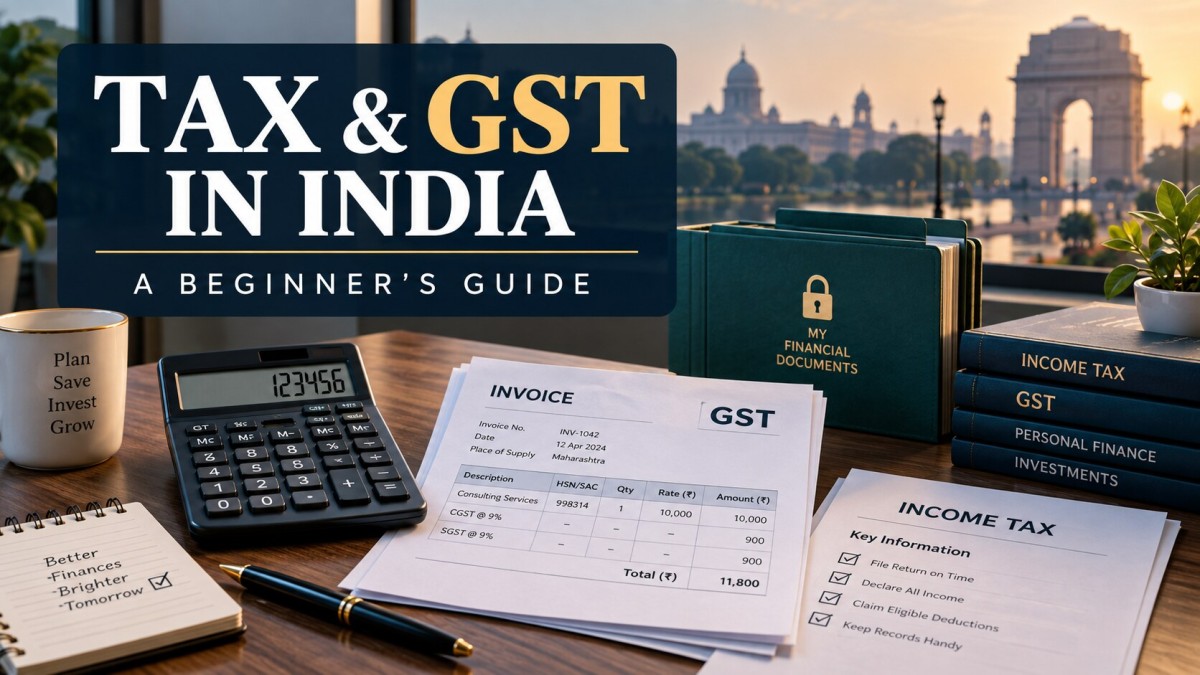

Tax and GST in India: A Beginner’s Guide

Understand the basics of income tax and GST in India, including direct and indirect taxes, PAN, ITR, TDS, GST registration, invoices, input tax credit, returns, and common compliance mistakes.

Sep 07, 2026 - 14:57
0 0
Tax and GST in India: A Beginner’s Guide

Tax and GST in India: A Beginner’s Guide

Taxes are an important part of India’s financial system. They help governments fund public services and infrastructure such as roads, schools, healthcare, administration, security, and welfare programmes.

For an individual, tax may arise from salary, business income, investments, property, or other sources. For a business, taxation can also involve the supply of goods and services, invoices, input tax credit, deductions, records, and periodic returns.

Two terms that beginners commonly encounter are Income Tax and Goods and Services Tax, or GST.

Income tax is generally a direct tax imposed on taxable income, while GST is an indirect tax connected with the supply of eligible goods and services.

Both operate under different laws, rules, portals, and compliance systems. Understanding the basic difference can help individuals and businesses maintain better records and avoid unnecessary mistakes.

What Is a Tax?

A tax is a compulsory financial charge imposed under law by a government or authorised public authority.

Taxes can generally be divided into two broad categories:

  • Direct taxes

  • Indirect taxes

Direct Tax

A direct tax is generally paid directly by the person or entity on whom it is imposed.

Income tax is a common example.

Depending on applicable law, income tax may apply to:

  • Individuals

  • Hindu Undivided Families

  • Firms

  • Companies

  • Associations

  • Other recognised taxpayers

The amount payable depends on factors such as taxable income, taxpayer category, tax regime, deductions, rebates, exemptions, and current law.

Indirect Tax

An indirect tax is usually collected by one person or business from another as part of a transaction and then deposited with the government.

GST is a major example of an indirect tax.

A registered supplier may collect applicable GST from the customer and report it through the GST system.

What Is Income Tax?

Income tax is a tax imposed on taxable income according to applicable income-tax law.

Taxable income is not always the same as the total amount received in a bank account. The calculation may depend on the nature of income, allowed expenses, exemptions, deductions, losses, rebates, and other rules.

Common income sources may include:

  • Salary or pension

  • Business or professional income

  • Income from house property

  • Capital gains

  • Interest and dividends

  • Rental income

  • Other taxable receipts

Different forms, reporting requirements, and tax treatments may apply to different types of income.

Income-tax Act, 2025 and the Tax Year

India introduced the Income-tax Act, 2025, with the new framework applying from 1 April 2026.

For income earned from 1 April 2026 onward, the concept of a Tax Year is used.

Older periods and related filings may continue to be handled under the law and terminology applicable to those periods.

Because India is transitioning between frameworks, taxpayers should select forms and guidance for the correct period instead of assuming that the same terminology and rules apply to every return.

What Is PAN?

PAN stands for Permanent Account Number.

It is a unique identification number used for income-tax and various specified financial purposes.

PAN may be required for:

  • Filing an income-tax return

  • Reporting certain financial transactions

  • Tax deduction records

  • Tax payments

  • Communication with the Income Tax Department

  • Specified banking or investment activities

A person should generally not hold more than one PAN. Personal details should be kept accurate and updated through official channels.

What Is an Income-tax Return?

An Income-tax Return or ITR is a prescribed form used to report income, deductions, taxes, and other required information for the relevant period.

Different ITR forms apply to different taxpayers and income situations.

The correct form may depend on:

  • Taxpayer status

  • Salary income

  • Business or professional income

  • Capital gains

  • Foreign income or assets

  • Property income

  • Other reporting conditions

Filing the wrong return form or leaving out important income may result in the return being treated as defective or requiring correction.

Does Everyone Have to File an ITR?

Not every person is automatically required to file the same return.

The requirement may depend on:

  • Total income

  • Type of income

  • Taxpayer category

  • Specified transactions

  • Foreign assets or income

  • Business conditions

  • Applicable law for the relevant period

A person may also file a return in certain permitted situations even when no tax is payable—for example, to claim an eligible refund or report information.

Always check the current official filing requirements.

What Is TDS?

TDS stands for Tax Deducted at Source.

Under the TDS system, a specified payer deducts tax from an eligible payment and deposits it with the government.

TDS may apply to certain payments such as:

  • Salary

  • Professional fees

  • Interest

  • Rent

  • Contract payments

  • Commission

  • Other specified transactions

TDS deducted does not always represent the taxpayer’s final tax liability.

The final calculation may result in:

  • Additional tax payable

  • No further tax

  • An eligible refund

Taxpayers should match TDS information with official tax statements and their own records.

What Are Form 16, Form 26AS and AIS?

Form 16

Form 16 is generally issued by an employer and contains specified salary and TDS information.

Form 26AS

Form 26AS is a tax credit statement that may show information such as TDS, TCS, tax payments, and specified transactions.

Annual Information Statement

The Annual Information Statement or AIS provides a wider view of information available to the Income Tax Department.

It may include details relating to:

  • Interest

  • Dividends

  • Securities transactions

  • Property transactions

  • Foreign remittances

  • Tax deductions

  • Other reported financial activity

Taxpayers should compare these records with bank statements, salary documents, investment reports, and their own calculations.

Information appearing in a statement should be reviewed rather than copied blindly if it appears incorrect or duplicated.

Basic Income-tax Filing Process

A general filing process may include:

Step 1: Identify the Correct Tax Period

Select the correct Tax Year or Assessment Year according to the income period and applicable law.

Step 2: Collect Documents

Documents may include:

  • PAN and identification details

  • Salary statements

  • Bank-interest certificates

  • Investment statements

  • Capital-gain reports

  • Property information

  • Business accounts

  • TDS certificates

  • Tax-payment receipts

  • Form 26AS and AIS

Step 3: Select the Correct ITR Form

Choose the form based on your taxpayer status and sources of income.

Step 4: Calculate Taxable Income

Report income under the correct categories and claim only eligible deductions, exemptions, losses, and credits.

Step 5: Pay Applicable Tax

Pay any remaining self-assessment tax through official channels.

Step 6: File the Return

Submit the return using the official Income Tax e-Filing Portal or another legally permitted method.

Step 7: Verify the Return

A return may need to be verified through an approved method within the applicable period.

Submitting a return without completing required verification may leave the filing incomplete.

Step 8: Preserve Records

Keep supporting documents and filing acknowledgements for the required period.

What Is GST?

GST stands for Goods and Services Tax.

GST is an indirect tax connected with the supply of eligible goods and services.

A registered supplier may charge GST on a taxable supply, collect it from the customer, report transactions, claim eligible input tax credit, and deposit the applicable net tax liability.

GST treatment depends on factors such as:

  • Nature of the supply

  • Type of goods or services

  • Supplier and recipient locations

  • Registration status

  • Place-of-supply rules

  • Exemptions

  • Applicable rate

  • Input-tax-credit eligibility

  • Reverse-charge provisions

  • Other legal conditions

GST should not be calculated only by looking at a product name. Correct classification and transaction facts matter.

Types of GST

India uses different GST components depending on the nature of the supply.

CGST

Central Goods and Services Tax may apply to eligible intra-state supplies and is collected by the Central Government.

SGST

State Goods and Services Tax may apply along with CGST to eligible intra-state supplies and is collected by the relevant State Government.

UTGST

Union Territory Goods and Services Tax may apply with CGST in eligible Union Territory transactions.

IGST

Integrated Goods and Services Tax generally applies to eligible inter-state supplies and certain other transactions, including specified imports.

The correct GST component depends on the location of the supplier, place of supply, and applicable legal rules.

Simple GST Example

Suppose a registered business sells a taxable product.

The process may work like this:

  1. The business purchases goods or services and pays applicable GST.

  2. It sells a taxable product and charges GST to the customer.

  3. The sale is recorded through a tax invoice.

  4. Eligible input tax credit may be considered.

  5. The remaining tax liability is calculated.

  6. Required GST returns are filed.

  7. Applicable tax is paid through the GST system.

This is a simplified example. Actual treatment may differ because of eligibility conditions, blocked credits, reverse charge, composition scheme, place-of-supply rules, and other provisions.

What Is a GSTIN?

GSTIN stands for Goods and Services Tax Identification Number.

It is issued to a person registered under GST.

GSTIN may appear on:

  • Tax invoices

  • GST registration certificates

  • Return filings

  • E-way bills

  • E-invoices

  • Business documents

  • Official GST communication

Businesses should verify GSTIN details through official sources when necessary.

Who Needs GST Registration?

GST registration requirements depend on applicable law and business facts.

Factors may include:

  • Aggregate turnover

  • Nature of goods or services

  • State or Union Territory

  • Inter-state supplies

  • E-commerce activity

  • Reverse-charge obligations

  • Specific compulsory-registration categories

  • Exemptions and notifications

Registration thresholds and conditions can vary or change. A business should not rely on an old social-media post or a general number without checking its exact circumstances.

What Is a GST Invoice?

A GST-registered supplier making a taxable supply may need to issue a prescribed tax invoice.

Depending on the transaction, an invoice may require details such as:

  • Supplier name and GSTIN

  • Invoice number and date

  • Recipient information

  • Description of goods or services

  • HSN or SAC information

  • Quantity and value

  • Taxable value

  • GST rate

  • CGST, SGST, UTGST, or IGST amount

  • Place-of-supply details

  • Other required declarations

The exact requirements depend on the transaction and current rules.

Invoices should use a controlled numbering system and be preserved properly.

What Is Input Tax Credit?

Input Tax Credit or ITC is the eligible credit of GST paid on certain business purchases or expenses that may be used against specified output GST liability.

For example, a registered business may pay GST when purchasing eligible goods and collect GST when selling taxable goods.

Subject to conditions, it may claim eligible credit for the GST paid on purchases and pay the balance.

ITC is not available automatically for every expense.

Eligibility may depend on conditions such as:

  • Possession of a valid document

  • Receipt of goods or services

  • Supplier reporting

  • Appearance in applicable system-generated statements

  • Payment-related conditions

  • Filing requirements

  • Time limits

  • Business use

  • Credit not being specifically blocked

Businesses should reconcile their purchase records with relevant GST statements and correct differences promptly.

What Are GST Returns?

GST returns are prescribed statements used to report relevant business transactions, tax liability, eligible credits, and other required information.

The forms and filing frequency depend on the taxpayer’s:

  • Registration type

  • Turnover

  • Scheme

  • Nature of business

  • Filing obligations

  • Current notifications

Commonly encountered returns may include outward-supply reporting and a summary return for declaring liabilities and eligible credits.

A return should be prepared using accurate sales, purchase, invoice, debit-note, credit-note, and tax-payment records.

A return showing no transactions may still be required in some circumstances if the registration remains active and the filing obligation continues.

What Is GSTR-2B?

GSTR-2B is a system-generated statement that provides input-tax-credit information for a tax period.

Businesses may use it during ITC reconciliation, but credit should be claimed only when all applicable legal conditions are satisfied.

A figure appearing in GSTR-2B does not by itself override every other eligibility condition.

What Is the Composition Scheme?

The composition scheme is a simplified GST arrangement available to certain eligible taxpayers, subject to conditions and limits.

It may involve:

  • Simplified tax calculation

  • Different return requirements

  • Restrictions on collecting tax

  • Limitations on input tax credit

  • Turnover and business-activity conditions

It is not automatically better for every small business.

A business should compare its customers, purchases, margins, interstate activity, tax-credit needs, and compliance position before choosing.

What Is Reverse Charge?

Under the usual GST system, the supplier pays the applicable tax.

Under Reverse Charge Mechanism, the recipient may become responsible for paying GST in specified transactions.

Reverse charge applies only in situations covered by current law or notifications. Its impact on invoicing, payment, credit, and returns should be reviewed carefully.

What Are HSN and SAC Codes?

HSN

Harmonised System of Nomenclature codes are used to classify goods.

SAC

Services Accounting Codes are used to classify services.

Correct classification helps determine the applicable rate, exemptions, invoice requirements, and reporting.

Using an incorrect code may result in tax, interest, invoice, or compliance problems.

GST Compliance Process for a Business

Step 1: Determine Registration Requirements

Check whether registration is required or suitable for the business.

Step 2: Maintain Accurate Records

Record every sale, purchase, invoice, debit note, credit note, expense, and payment.

Step 3: Classify Supplies Correctly

Determine whether the transaction involves goods or services, the classification code, tax rate, and exemption status.

Step 4: Determine the Place of Supply

Establish whether CGST with SGST/UTGST or IGST applies.

Step 5: Issue Correct Documents

Create tax invoices, bills of supply, debit notes, or credit notes as applicable.

Step 6: Reconcile Input Tax Credit

Compare purchase records with system-generated information and supplier reporting.

Step 7: File Applicable Returns

File the correct returns within the applicable deadlines.

Step 8: Pay Tax and Other Amounts

Pay the net liability, interest, late fee, or other applicable amounts through official channels.

Step 9: Respond to Notices

Do not ignore portal messages, notices, or registration-related communication.

Step 10: Preserve Supporting Records

Maintain records for the legally required period.

Difference Between Income Tax and GST

Income Tax GST
A direct tax An indirect tax
Generally based on taxable income Generally connected with taxable supplies
Paid by the person or entity earning taxable income Usually collected through eligible business transactions
Filed through the Income Tax system Filed through the GST system
Uses PAN and related taxpayer identification Registered taxpayers use GSTIN
May involve ITR, TDS and tax payments May involve invoices, ITC, GST returns and tax payments
Applies under income-tax law Applies under GST law

A business may have both income-tax and GST obligations because they apply to different aspects of its activities.

Paying GST does not automatically remove income-tax liability, and paying income tax does not replace GST compliance.

Tax Planning and Tax Evasion

Tax planning means arranging finances within the law while correctly using applicable deductions, exemptions, structures, and options.

Tax evasion involves illegally hiding income, creating false expenses, issuing fake invoices, suppressing sales, or deliberately providing incorrect information.

Tax planning is legal when based on genuine transactions and applicable law. Tax evasion can result in tax demands, interest, penalties, prosecution, or other action.

Common Income-tax Mistakes

  • Choosing the wrong ITR form

  • Missing interest or investment income

  • Ignoring capital gains

  • Failing to match TDS details

  • Not checking AIS or Form 26AS

  • Claiming an ineligible deduction

  • Using the wrong tax period

  • Filing without completing verification

  • Ignoring notices

  • Missing foreign-asset reporting

  • Not preserving supporting documents

  • Sharing portal credentials or OTPs

Common GST Mistakes

  • Charging the wrong GST rate

  • Using the wrong HSN or SAC code

  • Applying CGST and SGST when IGST is required

  • Claiming ineligible ITC

  • Failing to reconcile purchase records

  • Issuing incomplete invoices

  • Missing return deadlines

  • Ignoring reverse-charge liability

  • Not reporting credit or debit notes

  • Mixing personal and business expenses

  • Continuing to use an incorrect GSTIN

  • Ignoring registration cancellation or suspension notices

Tax and GST Safety Tips

  • Use only official government portals

  • Keep login credentials secure

  • Never share OTPs or passwords

  • Verify payment challans before paying

  • Avoid unknown refund links

  • Do not install unverified remote-access software

  • Check the professional credentials of advisers

  • Keep filing acknowledgements and receipts

  • Review notices through the official portal

  • Do not transfer tax payments into an individual’s personal account

  • Be cautious of calls threatening immediate arrest or account blocking

The Income Tax Department does not ask taxpayers to share banking passwords, card PINs, or similar confidential information by email.

Frequently Asked Questions

Are Income Tax and GST the Same?

No. Income tax is generally charged on taxable income, while GST is an indirect tax connected with eligible supplies of goods and services.

Does a Salaried Person Need GST Registration?

Salary received in the course of employment is generally treated differently from a taxable business supply. However, a salaried person with freelance, professional, rental, or business activities may need separate tax analysis.

Does Every Business Need GST Registration?

No single answer applies to every business.

Registration depends on turnover, activity, location, supply type, compulsory-registration provisions, and current law.

Can I Claim GST Paid on Every Purchase?

No. Input tax credit is subject to eligibility conditions, business use, documents, reporting, deadlines, and blocked-credit rules.

Does GST Registration Mean No Income Tax Is Payable?

No. GST and income tax are separate systems. A GST-registered business may also have income-tax obligations.

Can I File Tax and GST Returns Myself?

Some straightforward filings may be completed independently using official portals.

Professional assistance may be useful when there are multiple income sources, business transactions, capital gains, foreign assets, complex ITC, interstate supplies, notices, or classification questions.

Are Tax Rates and GST Rates Permanent?

No. Tax slabs, GST rates, deductions, exemptions, thresholds, forms, and procedures may change.

Always check current official information for the relevant period.

Final Thoughts

Income tax and GST are different but important parts of financial and business compliance in India.

Income-tax compliance requires correct reporting of taxable income, deductions, tax credits, and other prescribed information.

GST compliance requires businesses to understand registration, supply classification, invoices, input tax credit, returns, and payment obligations.

A responsible taxpayer should:

  • Maintain complete records

  • Use the correct tax period

  • Choose the correct return

  • Reconcile official statements

  • Issue proper invoices

  • Claim only eligible deductions and credits

  • File within applicable deadlines

  • Use official portals

  • Respond to notices

  • Seek qualified advice when necessary

Good tax compliance is not only about paying tax. It is about reporting the correct information, using the correct process, and keeping evidence that supports every important figure.


Disclaimer: This article is for general educational purposes only. It does not constitute tax, GST, accounting, financial, or legal advice. Tax laws, rates, thresholds, forms, deadlines, and procedures may change. Check current official notifications and consult a qualified tax professional for advice based on your circumstances.

What's Your Reaction?

Like Like 0
Dislike Dislike 0
Love Love 0
Funny Funny 0
Wow Wow 0
Sad Sad 0
Angry Angry 0

Comments (0)

User