

Trading and Crypto in India: A Practical Beginner’s Guide to Risk and Security
A practical guide to trading and cryptocurrency in India, covering market basics, leverage, security, scams, records and risk management.
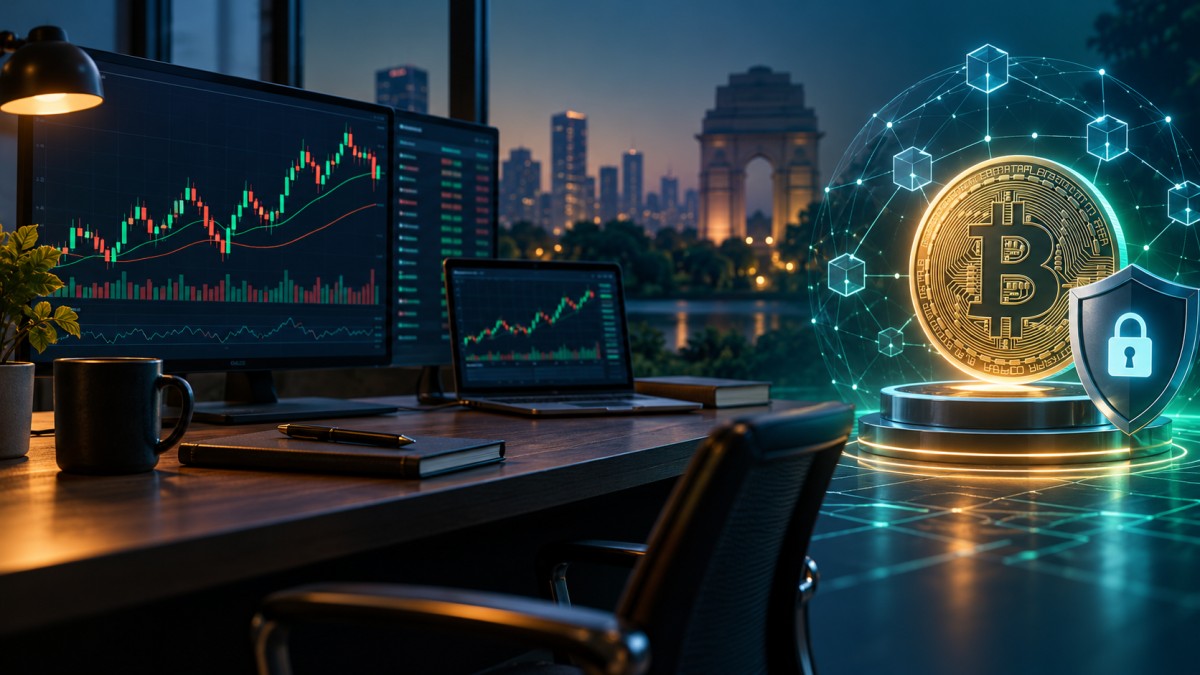
Trading and cryptocurrency are often discussed as if they were the same thing. They are not. Trading is a way of buying and selling an asset with the aim of benefiting from a price change; cryptocurrency is a type of digital asset that can be traded, held or used on a blockchain network. A person can trade company shares, currencies, commodities or crypto tokens, and each market has different risks.
This guide is for someone in India who is still at the starting line. It explains the moving parts in plain language, shows where beginners usually lose money, and gives you a safer process for learning. It does not promise returns or recommend a particular coin, broker or exchange. The most useful first decision is not which asset to buy; it is how much money you can afford to put at risk.
Short answer: what is the difference between trading and crypto?
Trading is an activity. You buy and sell an asset based on a plan, a price level or a view about the market. Crypto is an asset category. Bitcoin, Ether and thousands of other tokens use different networks, rules and use cases, and their prices can move sharply at any time.
That distinction matters because the risk comes from two directions. A trader can make a poor decision in a relatively established market, while a crypto participant can face both a poor trading decision and additional risks such as a hacked wallet, a failed platform, a misleading token or a change in local rules.
What does trading actually involve?
Every trade has four basic parts: an entry, a position size, an exit plan and a cost. Suppose an asset is bought at ₹500 and later sold at ₹520. The gross gain is ₹20 per unit, not the final profit. Brokerage, exchange fees, taxes, spread and possible slippage reduce the amount that reaches your account. If the price moves to ₹480 instead, the same calculation becomes a loss.
The chart is only one part of the decision. A sensible plan also asks: Why am I entering? What would prove my idea wrong? How much will I lose if that happens? How long am I willing to hold? If these answers are missing, the trade is usually a reaction to excitement, fear or someone else’s message.
Trading and investing are different approaches
| Point | Trading | Investing |
|---|---|---|
| Main focus | Short- or medium-term price movement | Long-term value and growth |
| Typical activity | More frequent decisions and transactions | Fewer decisions, often with periodic review |
| Important skill | Execution, risk control and discipline | Research, valuation and patience |
| Main danger | Overtrading and emotional losses | Buying an unsuitable asset or ignoring changes |
Neither approach is automatically safer. A long holding period does not repair every bad purchase, and frequent trading is not a shortcut to quick income. Choose the approach that matches your time, knowledge, cash flow and ability to handle losses.
Crypto basics without the hype
A blockchain is a shared record maintained by a network of computers. Transactions are grouped and verified according to the network’s rules. A cryptocurrency or token is an asset recorded on such a network, but different tokens can have very different purposes. Some are designed as digital money, some help operate a network, some represent access to a service, and some have little beyond speculation behind them.
Bitcoin is the best-known crypto asset and operates on its own blockchain. Ether is the native asset of Ethereum, a network that supports smart contracts and applications. Stablecoins aim to track the value of another asset, commonly a currency, but “stable” describes an objective, not a guarantee. The reserve, issuer, redemption process and market liquidity still matter.
Before buying any token, find out who controls the project, what the token is meant to do, how its supply can change, where it trades, and what happens if the project stops operating. A white paper can contain useful information, but it is not proof that a project is sound.
Spot, margin and derivatives: know what you are buying
- Spot trading: you buy or sell the asset at the current market price. In crypto, the token is generally credited to your exchange account or wallet, subject to the platform’s process.
- Margin trading: you use borrowed funds or collateral to control a larger position. Interest, liquidation rules and fast losses make this unsuitable for many beginners.
- Futures and other derivatives: the contract derives its value from an underlying asset. You may be able to profit when prices fall, but the contract can expire, be liquidated or create losses larger than expected.
Leverage magnifies the position, not your skill. For example, ₹10,000 used as margin might support a ₹1,00,000 position at 10x leverage. A 2% adverse move on that larger position is ₹2,000 before costs, which is 20% of the original margin. A larger move can trigger an automatic liquidation. “Low margin” therefore does not mean “low risk.”
How traders study a market
Fundamental research
Fundamental research looks at what may support an asset over time. For a company, this can include revenue, cash flow, debt, competition, management and valuation. For a crypto project, it can include the network’s purpose, developer activity, token distribution, governance, security history and actual usage. The questions differ by asset, so copying a stock checklist onto a token is not enough.
Technical analysis
Technical analysis studies price and volume. Support and resistance, trends, moving averages and momentum indicators can help organise a plan. They do not predict the future. A pattern becomes less useful when the market is thin, news causes a sudden move or many traders are looking at the same level.
News and market conditions
Interest-rate decisions, company announcements, regulations, exchange outages, hacks and large liquidations can change prices quickly. Always check the original announcement instead of relying only on a screenshot or a social-media post. A headline may describe an intention, while the final rule or filing says something narrower.
Risk management is the part beginners should learn first
A good risk process keeps one wrong idea from damaging your finances. Consider these habits:
- Separate essential money. Do not use rent, emergency savings, borrowed money or money needed for near-term obligations.
- Decide the maximum loss before entering. Position size should follow the amount you can accept losing, not the amount a platform says you can buy.
- Use an exit plan. A stop order can help automate an exit, but it is not a guaranteed price. In a fast or illiquid market, execution may be worse than the trigger price.
- Count every cost. Include brokerage, spread, platform charges, funding or interest, conversion costs and taxes where applicable.
- Limit concentration. Holding one volatile token or one sector does not provide meaningful diversification.
- Keep a journal. Record the reason for the trade, entry, planned exit, size, result and emotion. Review the process, not just the profit or loss.
- Stop after a bad run. Revenge trading usually increases size at exactly the time judgement is weakest.
A useful rule is simple: if a loss would make you borrow money, miss a bill or lose sleep, the position is too large. There is no prize for taking the maximum risk available on an app.
Wallets, custody and account security
On an exchange, the platform generally controls the private-key infrastructure while your account records your balance. In a self-custody wallet, you control the private key or recovery phrase. Self-custody can reduce dependence on a platform, but it also transfers responsibility to you. A lost recovery phrase may mean permanent loss, and a mistaken transfer can be difficult or impossible to reverse.
- Use a unique, long password and enable app-based two-factor authentication where available.
- Never share a recovery phrase, private key, one-time password or remote-access code.
- Ignore anyone who promises to “unlock” funds after receiving an upfront payment.
- Check the full wallet address and network before confirming a transfer. A similar-looking network or address can send funds to the wrong place.
- For a self-custody wallet, keep the recovery phrase offline and never store it in a screenshot, public cloud folder or chat.
- Test a small transfer first when you are unfamiliar with a platform or network.
Bookmark the genuine website or open the service through a trusted app store listing. Search advertisements and social posts can lead to lookalike login pages designed to steal passwords or recovery phrases.
What beginners in India should check
Rules, reporting requirements, fees and platform availability can change. Before trading, read current information from official or regulated sources and keep records of deposits, withdrawals, purchases, sales, fees and transfers. Do not rely on a two-year-old video for a current compliance decision.
For investor education and information about the securities market, start with SEBI’s investor education resources. For information related to reporting entities and the financial-intelligence framework, consult the Financial Intelligence Unit–India. For tax guidance and account services, check the current material on the Income Tax Department portal. The Reserve Bank of India website is also an important source for official notices and banking-related information.
Crypto tax treatment and transaction reporting can depend on the type of transaction and the rules in force at the time. Keep complete records and speak with a qualified tax professional if your activity is more than occasional or your transactions are complex. This is safer than copying a percentage from an influencer’s post.
Scams that target new traders
Scammers often use urgency, guaranteed returns and fake authority. Common examples include “fixed daily profit” groups, celebrity giveaways, fake customer-support accounts, recovery services, copy-trading promises and new tokens promoted only through referral links. A request to deposit more money to release a withdrawal is a major warning sign.
Ask three questions before sending money: Can I independently verify the person or company? Where is the original evidence? What happens if the claim is wrong? If the answer depends on secrecy, urgency or recruiting friends, walk away. Missing one opportunity is cheaper than recovering from a fraudulent transfer.
A sensible learning plan for the first 30 days
- Week 1: learn order types, fees, liquidity, volatility, custody and the difference between spot and derivatives.
- Week 2: follow a small watchlist and write down why prices moved. Do not place a trade just to stay involved.
- Week 3: practise a written entry and exit plan using a spreadsheet or paper. Include the maximum rupee loss and all estimated costs.
- Week 4: if you still want to begin, use only an amount you can afford to lose, start without leverage, make small decisions and review your journal.
Learning with a simulator can help with order mechanics, but it cannot reproduce the fear, greed, slippage or platform failure of a real position. Treat simulated success as practice—not evidence that profits are guaranteed.
Frequently asked questions
Is crypto the same as the stock market?
No. Shares represent an interest in a company and trade within a securities-market framework. Crypto assets use different networks and ownership structures. The risks, market hours, disclosures and rules are not identical.
Can a beginner start trading with ₹500?
A small amount can be useful for learning mechanics, but it does not make trading safe or reliably profitable. Fees, minimum order sizes and price volatility may have a large effect on a small account. Start only after essential expenses and emergency savings are covered.
Is leverage good for beginners?
Usually not. Leverage increases the size of gains and losses and can cause liquidation after a relatively small market move. Understand unleveraged spot transactions before considering any borrowed exposure.
Are stablecoins risk-free?
No. They can face issuer, reserve, redemption, network, platform and market-liquidity risks. A stablecoin may trade away from its intended reference value during stress.
Should I follow Telegram or WhatsApp trading signals?
Signals can be incomplete, delayed or deliberately used to create demand. Do your own verification and never give a group admin control of your account, wallet or recovery phrase.
How do I choose a crypto platform?
Check identity and withdrawal procedures, security controls, fee schedules, supported networks, custody arrangements, customer support and the legal information the platform provides. Read the terms before depositing money, and test a small withdrawal.
What is the safest trading strategy?
There is no universally safest strategy. A clear plan, small position size, no essential-money risk, limited leverage and careful records reduce avoidable mistakes, but they cannot remove market risk.
Final takeaway
Trading and crypto can be studied, but they should not be presented as effortless income. Start with definitions, security and risk limits. Check current information from primary sources, question guarantees, and measure success by whether you followed a sensible process—not by one lucky trade.
Last reviewed: September 2026
This article is for general educational purposes only. It is not personalised investment, legal or tax advice. Trading and crypto assets can cause substantial losses. Rules, fees and platform terms may change; verify current details through official sources before making a decision.
What's Your Reaction?
 Like
0
Like
0
 Dislike
0
Dislike
0
 Love
0
Love
0
 Funny
0
Funny
0
 Wow
0
Wow
0
 Sad
0
Sad
0
 Angry
0
Angry
0

Software developer with expertise in full-stack web development and financial market analysis, specializing in building tracking tools for trading metrics.





Comments (0)