AI Career Skills in India: A Practical Roadmap for Students and Professionals
A practical 12-week roadmap to build AI career skills through domain knowledge, data literacy, prompting, verification and portfolio projects.
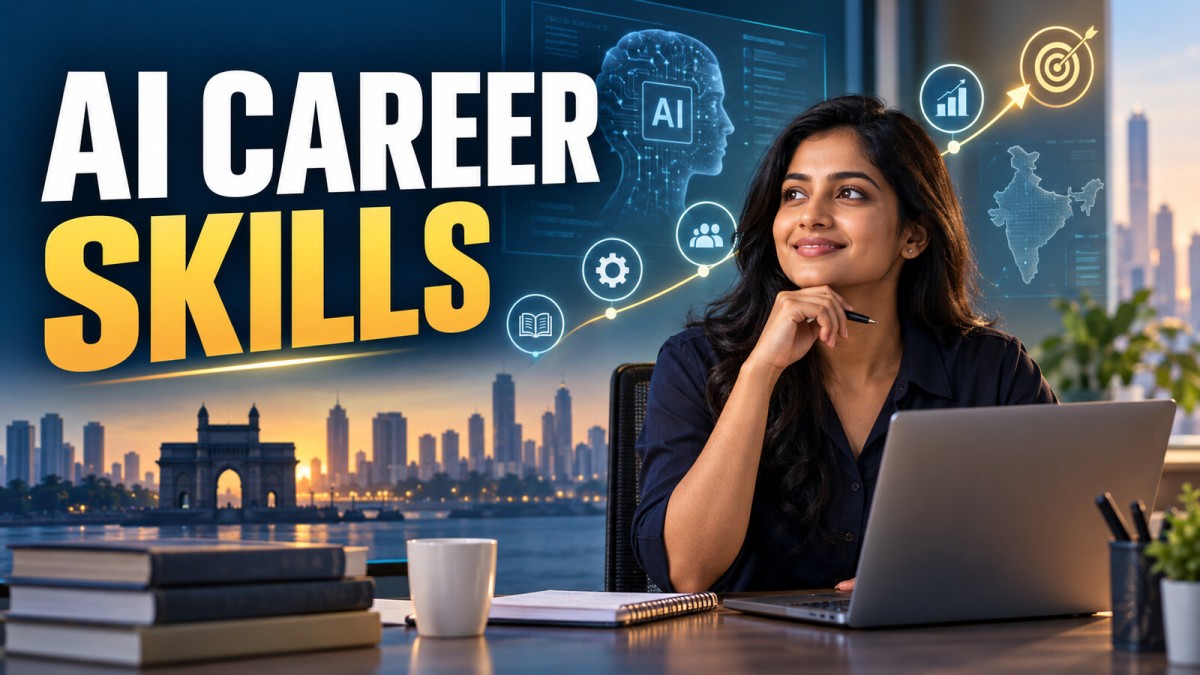
Artificial intelligence is changing how people research, write, analyse data, build software and serve customers. That does not mean every job will disappear or that everyone must become a machine-learning engineer. For most students and working professionals, the practical goal is to combine strong domain knowledge with data literacy, AI tools, judgement and communication.
This guide offers a realistic roadmap for building AI-era career skills in India. It focuses on employability and responsible learning, not guaranteed salaries or overnight success.
Begin With Your Existing Career Direction
AI is a layer that can improve many professions. A finance professional may use it to review reports; a developer may use it to draft tests; a marketer may explore campaign ideas; a teacher may prepare practice material. The strongest career plan usually combines AI capability with a real field rather than collecting random tool certificates.
Ask three questions:
- Which problems do I already understand?
- Which repetitive tasks in this field can AI assist?
- Which decisions still require human responsibility and domain expertise?
The Six-Part AI Career Skill Stack
1. Domain knowledge
Learn the rules, vocabulary, customer needs and quality standards of your chosen field. AI can produce a polished answer, but without domain knowledge you may not notice a serious mistake. A healthcare worker, accountant, designer and software developer each need different verification skills.
2. Data literacy
You should be comfortable reading tables, percentages, averages, trends and basic charts. Learn how data is collected, what a missing value means and why a biased sample can lead to a poor conclusion. Spreadsheet skills remain valuable even when an AI assistant helps create formulas.
3. Prompting and task design
Prompting is not about memorising secret phrases. It is the ability to describe a task, supply relevant context, define constraints and evaluate the result. Break a complicated assignment into smaller steps, request a clear output format and tell the model what to do when information is missing.
4. Verification and critical thinking
Check sources, test calculations and compare claims with original documents. When a result feels unusually certain or convenient, investigate it. AI fluency can make weak information look trustworthy, so verification is a core professional skill.
5. Automation and technical foundations
Not every role requires programming, but basic automation can create leverage. Start with spreadsheets and no-code workflows. Technical learners can add Python or JavaScript, APIs, databases, Git and cloud basics. Understanding how systems exchange data is often more useful than learning one temporary interface.
6. Communication and responsibility
Explain what the AI did, what data it used, where uncertainty remains and who approved the result. Professionals who can communicate limitations clearly are safer collaborators than people who present every generated answer as certain.
Choose a Learning Path
Path A: AI-enabled professional
This path suits people in sales, operations, finance, HR, education, content, design or customer service. Learn prompting, document analysis, spreadsheet assistance, privacy basics and workflow measurement. Build examples related to your real profession.
Path B: Developer building AI features
Learn one programming language well, then add APIs, JSON, authentication, databases, testing and deployment. Build simple applications that connect a model to verified data. Study security topics such as prompt injection, access control, secrets management and logging.
Path C: Data and machine-learning practitioner
Develop stronger foundations in Python, statistics, linear algebra, data cleaning and model evaluation. Learn supervised and unsupervised learning before focusing only on generative AI. Projects should include an explanation of the dataset, assumptions, metrics and limitations.
Path D: AI governance, policy or risk
Organisations also need people who can create policies, assess vendors, map risks, test systems and document accountability. This path benefits from knowledge of privacy, cybersecurity, regulation, audit and the organisation’s industry.
A Practical 12-Week Roadmap
Weeks 1–2: Foundations. Learn what AI, machine learning, generative AI, models, prompts and hallucinations mean. Practise separating a claim from its supporting evidence.
Weeks 3–4: Everyday workflows. Use an approved tool for summaries, outlines and data explanations. Record the prompt, output, corrections and time taken.
Weeks 5–6: Data skills. Clean a small spreadsheet, create formulas and explain a chart. Technical learners can repeat the exercise with Python and a notebook.
Weeks 7–8: Build one project. Choose a genuine problem: a searchable FAQ, expense categoriser, document checklist, support-response assistant or portfolio analyser. Keep the scope small enough to finish.
Weeks 9–10: Test and document. Create normal, edge-case and adversarial test examples. Record failures, privacy decisions and what requires human review.
Weeks 11–12: Publish and explain. Prepare a short case study, screenshots, demo and source repository where appropriate. Explain the problem, your contribution, the tools, measurable outcome and limitations.
What Makes a Strong AI Portfolio Project?
A good project proves judgement, not just API usage. Employers should be able to see why the problem matters and how you evaluated the result.
- A clear user and real problem
- A small, lawful and well-described dataset
- Baseline performance before AI was added
- Tests for accuracy, failure cases and unsafe inputs
- Privacy and security decisions
- Human-review points
- A short demonstration and honest limitations
A portfolio with two completed, well-documented projects is usually more convincing than a long list of unfinished tutorials.
Certificates: Useful, but Not Enough
A structured course can provide discipline and foundational knowledge. However, a certificate does not prove that you can solve a workplace problem. Pair each course with a project, written explanation or presentation. Be specific about what you personally built instead of claiming credit for an entire team’s output.
How to Use AI During a Job Search
AI can help organise experience, identify missing keywords and practise interview questions. Keep every statement truthful. Do not invent qualifications, employers, project results or references. A resume should describe your real work in your own career context.
For interviews, practise explaining:
- How you verified an AI-generated answer
- A time the system failed and what you changed
- How you protected confidential information
- Which metric you used to judge success
- Where a human decision remained necessary
Skills That Remain Valuable as Tools Change
Specific products will change, but problem definition, writing, mathematics, software fundamentals, data quality, customer understanding, ethical judgement and communication are durable. Learn enough about tools to work efficiently, while investing most deeply in transferable foundations.
Avoid Common Career Mistakes
- Claiming to be an expert after a short course
- Building copied projects without understanding the code
- Uploading confidential employer data to public tools
- Focusing only on prompting while ignoring domain knowledge
- Using unverified statistics in a portfolio or interview
- Expecting a salary guarantee from any course or certificate
Final Takeaway
An AI-ready career is built by combining a real professional foundation with practical AI use, data literacy and responsible verification. Choose one path, complete a small project, document your decisions and keep learning. The goal is not to compete with every new tool; it is to become the person who can use technology to solve a meaningful problem safely.
Further Reading
Disclaimer: This article is educational and does not guarantee employment, promotion or income. Hiring requirements vary by role, employer and location.
What's Your Reaction?
 Like
0
Like
0
 Dislike
0
Dislike
0
 Love
0
Love
0
 Funny
0
Funny
0
 Wow
0
Wow
0
 Sad
0
Sad
0
 Angry
0
Angry
0

Software developer with expertise in full-stack web development and financial market analysis, specializing in building tracking tools for trading metrics.





Comments (0)