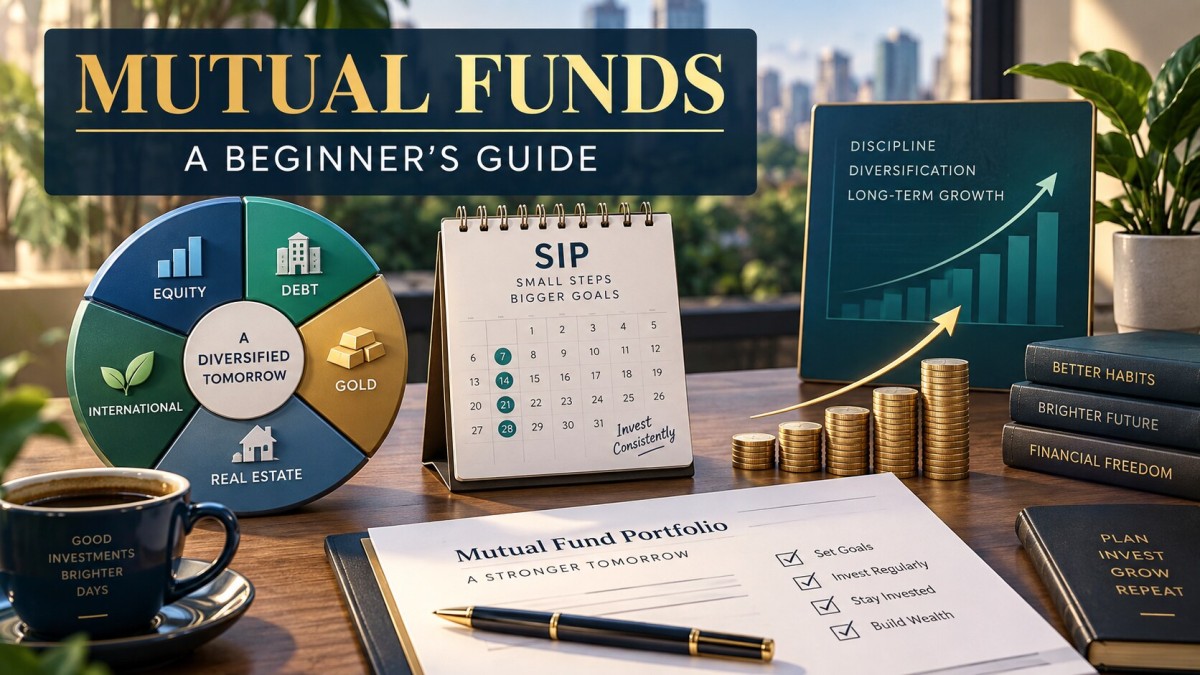

What Are Mutual Funds? A Beginner’s Guide to Investing
Learn how mutual funds work, their major types, SIP and lump-sum investing, NAV, expense ratios, risks, and the steps beginners should follow before investing.
What Are Mutual Funds? A Beginner’s Guide to Investing
Many people want to invest for their future but may not have the time, experience, or confidence to select and monitor individual shares or bonds.
Mutual funds provide one way to access a professionally managed portfolio.
A mutual fund is an investment vehicle that collects money from multiple investors and invests it in shares, bonds, money-market instruments, gold, or other permitted assets according to a defined objective.
In return for the invested money, investors receive units of the mutual fund scheme. The value of these units changes according to the performance of the scheme’s underlying investments and applicable expenses.
Mutual funds can make diversification and professional management more accessible, but they are not free from risk. Returns are not guaranteed, and the value of an investment may rise or fall.
How Does a Mutual Fund Work?
A mutual fund pools money from many investors who have invested in the same scheme.
The Asset Management Company manages this pooled money according to the scheme’s stated investment objective.
For example, an equity mutual fund may primarily invest in company shares, while a debt fund may invest in bonds and other debt instruments.
The basic process works like this:
-
Investors put money into a mutual fund scheme.
-
The scheme issues units to investors.
-
The fund manager invests the pooled money.
-
The value of the underlying portfolio changes.
-
The scheme’s Net Asset Value reflects the per-unit value.
-
Investors may redeem their units according to applicable conditions.
The fund’s performance depends on its investments, market conditions, expenses, and investment strategy.
Who Manages a Mutual Fund?
Several entities are involved in operating and supervising a mutual fund.
Sponsor
The sponsor is similar to a promoter who establishes the mutual fund, subject to regulatory requirements.
Trustees
Trustees oversee the mutual fund and are expected to protect the interests of unit holders.
Asset Management Company
The Asset Management Company or AMC manages mutual fund schemes.
It appoints investment professionals and handles activities such as portfolio management, operations, reporting, and investor services.
Fund Manager
A fund manager makes investment decisions for an actively managed scheme according to its stated objective and strategy.
In a passively managed fund, the portfolio is generally designed to track a selected index rather than depend on active security selection.
Custodian
The custodian holds the scheme’s securities and performs related custody functions.
Registrar and Transfer Agent
The Registrar and Transfer Agent helps maintain investor records and process transactions and service requests.
What Are Mutual Fund Units?
When you invest in a mutual fund, you receive units of the scheme.
The number of units allotted generally depends on:
-
Amount invested
-
Applicable Net Asset Value
-
Transaction date and time
-
Realisation of funds
-
Scheme and regulatory conditions
The applicable NAV may depend on when the investment money is available to the mutual fund, not merely when the transaction is initiated.
Investors should check current cut-off and applicable-NAV rules before relying on a particular transaction date.
What Is NAV?
NAV stands for Net Asset Value.
It represents the per-unit value of a mutual fund scheme after considering its assets and liabilities according to the applicable valuation process.
A simplified representation is:
NAV = Net value of the scheme’s assets ÷ Total outstanding units
A fund with an NAV of ₹20 is not automatically cheaper or better than a fund with an NAV of ₹200.
NAV alone does not show whether the fund is undervalued, safer, or likely to provide higher returns. Investors should examine the scheme’s portfolio, objective, costs, risk and performance instead.
Major Types of Mutual Funds
Mutual funds can be classified according to the assets they hold and the goals they are designed to serve.
Equity Mutual Funds
Equity funds invest mainly in company shares.
They may provide long-term growth potential, but their value can fluctuate significantly. Equity funds are generally more suitable for investors who understand market risk and have an appropriate time horizon.
Equity-fund categories may focus on:
-
Large-cap companies
-
Mid-cap companies
-
Small-cap companies
-
A combination of market capitalisations
-
Particular sectors or themes
-
Tax-saving strategies
-
International markets
Sectoral and thematic funds can carry concentration risk because their investments focus on a limited area.
Debt Mutual Funds
Debt funds invest in instruments such as:
-
Government securities
-
Corporate bonds
-
Treasury bills
-
Money-market instruments
-
Other permitted debt securities
Debt funds are not the same as fixed deposits, and their returns are not guaranteed.
They may face:
-
Interest-rate risk
-
Credit risk
-
Liquidity risk
-
Reinvestment risk
-
Market risk
Different debt-fund categories can have very different risk profiles.
Hybrid Mutual Funds
Hybrid funds invest in more than one asset class, usually a combination of equity and debt.
The level of risk depends on how much the scheme invests in each asset class and how the allocation is managed.
Do not assume every hybrid fund has low risk.
Index Funds
An index fund attempts to track the performance of a selected market index.
It generally invests in the securities included in that index according to the scheme’s methodology.
The fund may not deliver exactly the same return as the index because of expenses, cash holdings and tracking differences.
Exchange-Traded Funds
An Exchange-Traded Fund or ETF is a pooled investment product that trades on a stock exchange.
ETFs may track stock indices, bonds, gold or other assets. Buying and selling an ETF generally requires exchange access and may involve brokerage, bid-ask spreads, liquidity considerations and Demat-related costs.
Solution-Oriented Funds
Some schemes are designed around goals such as retirement or children’s financial planning.
These schemes may have specific restrictions or lock-in conditions. Read the scheme documents before investing.
Fund of Funds
A Fund of Funds invests in other mutual fund schemes instead of investing entirely in individual securities.
Investors should understand the underlying funds, combined expenses, asset allocation and taxation.
SIP and Lump-Sum Investing
Mutual fund investments may be made through a lump sum or a Systematic Investment Plan.
What Is a Lump-Sum Investment?
A lump-sum investment means investing a larger amount in a single transaction.
It may be suitable when an investor has money available and the investment fits the person’s goal, risk tolerance, time horizon and asset-allocation plan.
A lump sum can experience immediate market gains or losses after investment.
What Is a SIP?
SIP stands for Systematic Investment Plan.
A SIP allows an investor to invest a selected amount at regular intervals in a mutual fund scheme.
Potential advantages include:
-
Creating investment discipline
-
Making regular investing easier
-
Reducing the need to choose one perfect entry date
-
Buying more units when NAV is lower and fewer when NAV is higher
-
Supporting long-term goal-based investing
A SIP does not guarantee profit or prevent loss. It is only a method of investing regularly.
Stopping a SIP usually stops future instalments; it does not automatically redeem previously purchased units. The exact process depends on the platform and scheme conditions.
Direct Plans and Regular Plans
Many mutual fund schemes offer Direct and Regular plans.
Direct Plan
A Direct Plan is purchased directly from the mutual fund through eligible channels without routing the investment through a distributor.
It generally has a lower expense ratio because distribution expenses and commissions are not charged to the plan in the same way.
However, the investor is responsible for selecting and managing the investment or obtaining separate professional advice.
Regular Plan
A Regular Plan is purchased through a mutual fund distributor or intermediary.
Its expense ratio is generally higher because it includes eligible distribution-related expenses or commissions.
A higher cost does not automatically mean the investor receives personalised financial advice. Understand the intermediary’s role, services and compensation before investing.
Growth and Income-Distribution Options
A scheme may offer different options for handling income or gains, subject to its structure and current regulations.
Growth Option
Under the Growth Option, gains generally remain invested in the scheme and are reflected in its NAV.
This may be suitable for investors seeking long-term accumulation, depending on their goals and tax position.
Income Distribution Option
Under an Income Distribution cum Capital Withdrawal option, the scheme may make distributions subject to available distributable surplus and applicable rules.
Such distributions are not fixed or guaranteed. They may also include a return of part of the investor’s capital, and the NAV generally adjusts after distribution.
What Is an Expense Ratio?
The expense ratio represents the recurring expenses charged to manage and operate a mutual fund scheme.
These may include eligible investment-management, administration and operational costs.
The expenses are reflected in the scheme’s NAV. Investors do not usually receive a separate monthly bill.
Even a small difference in costs can affect long-term outcomes, especially when two funds deliver similar returns before expenses.
Compare expense ratios within relevant categories, but do not choose a fund based only on cost.
What Are Exit Loads?
An exit load is a charge that may apply when units are redeemed within a specified period.
Exit-load conditions vary between schemes and may depend on:
-
Time since investment
-
Amount redeemed
-
Type of scheme
-
Specific transaction conditions
Always check the current Scheme Information Document before investing or redeeming.
What Is the Riskometer?
The Riskometer is a standardised tool used to display the risk level of a mutual fund scheme.
Risk levels can range from low to very high.
The Riskometer can help investors understand the broad risk category, but it should not be the only factor used to select a fund.
Investors should also examine:
-
Investment objective
-
Portfolio holdings
-
Asset allocation
-
Credit quality
-
Interest-rate sensitivity
-
Concentration
-
Expense ratio
-
Investment horizon
Benefits of Mutual Funds
Diversification
A mutual fund can invest across multiple securities, which may reduce the effect of poor performance in one holding.
Diversification reduces concentration risk but does not guarantee against loss.
Professional Management
Investment professionals manage the portfolio according to the scheme’s objective.
Professional management does not guarantee better returns.
Accessibility
Many mutual funds allow investors to begin with relatively manageable amounts. Minimum investment requirements vary by scheme and transaction type.
Transparency
Mutual funds provide documents and disclosures such as:
-
Scheme Information Document
-
Key Information Memorandum
-
Portfolio disclosures
-
Factsheets
-
NAV information
-
Expense information
-
Riskometer
Liquidity
Many open-ended mutual funds permit redemption on business days, subject to applicable rules, cut-off timings, exit loads and settlement conditions.
Some funds may have lock-ins, restrictions or lower liquidity in their underlying assets.
Variety
Different schemes are available for different goals, time horizons, asset classes and levels of risk.
A larger number of choices also increases the importance of selecting carefully.
Risks of Mutual Funds
Market Risk
The value of underlying investments may fall because of market or economic conditions.
Credit Risk
A debt issuer may fail to make payments or may experience a decline in credit quality.
Interest-Rate Risk
Changes in interest rates can affect the market value of debt securities.
Liquidity Risk
The fund may face difficulty selling certain investments quickly at a reasonable price.
Concentration Risk
A scheme focused on a limited sector, theme or group of securities can experience larger losses if that area performs poorly.
Fund-Management Risk
The decisions of an active fund manager may not produce the expected results.
Tracking Error
An index fund or ETF may perform differently from the index it attempts to track.
Currency and International Risk
International funds may be affected by currency movements, overseas markets, taxation and geopolitical events.
Behavioural Risk
Investors may buy after strong performance and sell during temporary declines because of fear or FOMO.
How to Choose a Mutual Fund
Step 1: Define Your Goal
Decide what the investment is intended to achieve.
Examples include:
-
Retirement
-
Higher education
-
Buying a house
-
Building long-term wealth
-
Creating a short-term financial reserve
Step 2: Decide Your Time Horizon
A fund suitable for a long-term goal may be inappropriate for money needed within a few months.
Step 3: Understand Your Risk Tolerance
Select a level of risk you can manage financially and emotionally.
Step 4: Choose the Appropriate Category
First select a fund category that matches your goal. Comparing unrelated categories only by their recent returns can be misleading.
Step 5: Read the Scheme Documents
Review the:
-
Investment objective
-
Asset allocation
-
Risk factors
-
Benchmark
-
Expense ratio
-
Exit load
-
Minimum investment
-
Portfolio
-
Fund-management approach
Step 6: Examine Performance Properly
Do not look only at the highest one-year return.
Study performance over different market periods and compare it with the relevant benchmark and category.
Past performance does not guarantee future returns.
Step 7: Check Portfolio Risk
Look for excessive concentration, low-quality debt, unusual portfolio changes or risks that you do not understand.
Step 8: Select Direct or Regular
Choose based on whether you can make suitable decisions independently or require assistance from an intermediary.
Step 9: Invest Through Verified Channels
Use the mutual fund’s official website, a registered intermediary or another verified platform.
Step 10: Review Periodically
Review whether the fund continues to match your goal and risk profile.
Do not change funds only because another scheme recently delivered a higher return.
Common Mutual Fund Mistakes
-
Selecting a fund only because of recent returns
-
Assuming a lower NAV means a cheaper fund
-
Believing an NFO is automatically better
-
Investing without a financial goal
-
Ignoring the Riskometer
-
Comparing unrelated fund categories
-
Owning too many similar schemes
-
Ignoring expenses and exit loads
-
Investing emergency money in a volatile fund
-
Stopping investments during every market decline
-
Expecting a SIP to guarantee profit
-
Following social-media recommendations blindly
-
Investing without reading scheme documents
-
Ignoring tax implications
-
Sharing OTPs or account credentials
Mutual Fund Safety Tips
-
Complete KYC through authorised channels
-
Verify the AMC, distributor and platform
-
Never share an OTP, PIN or password
-
Check transaction confirmations
-
Review account statements regularly
-
Keep contact and nomination details updated
-
Avoid guaranteed-return claims
-
Do not transfer investment money to an individual’s personal account
-
Read documents before accepting any scheme
-
Use official grievance channels when necessary
Frequently Asked Questions
Are Mutual Funds Safe?
Mutual funds are regulated investment products, but regulation does not guarantee returns or prevent market losses.
Safety depends on the scheme’s assets, strategy, risk level and suitability for the investor.
Can I Start With a Small Amount?
Many schemes accept relatively small investments, but minimum amounts vary.
Check the current conditions of the selected scheme.
Is SIP Better Than a Lump Sum?
Neither method is universally better.
The appropriate method depends on available money, cash flow, market-risk tolerance, goal and investment plan.
Does SIP Guarantee Positive Returns?
No. A SIP creates regular investment discipline, but returns depend on market performance and the selected scheme.
Is a Fund With a Lower NAV Better?
No. NAV is the per-unit value of the scheme and does not indicate whether the fund is cheaper or likely to perform better.
Can I Withdraw Mutual-Fund Money Anytime?
Many open-ended funds permit redemption, but exit loads, cut-off rules and settlement periods may apply. Some schemes have lock-ins or other restrictions.
How Many Mutual Funds Should I Own?
There is no fixed number.
Owning several funds with very similar portfolios may create complexity without providing meaningful additional diversification.
Are Mutual-Fund Returns Guaranteed?
No. Mutual-fund returns are not guaranteed unless a specific guarantee is legally structured and clearly disclosed—which is not how ordinary market-linked schemes work.
Final Thoughts
Mutual funds allow investors to participate in professionally managed portfolios across equity, debt and other asset classes.
They can provide diversification, convenience and access to different investment strategies. However, choosing a mutual fund requires more than selecting the scheme with the highest recent return.
A responsible investor should:
-
Define a financial goal
-
Understand the time horizon
-
Assess risk tolerance
-
Select the correct fund category
-
Read scheme documents
-
Compare costs and risks
-
Invest through verified channels
-
Review the investment periodically
A mutual fund is a tool—not a complete financial plan. Its value depends on whether the scheme is suitable for your goal, timeline and ability to handle risk.
Disclaimer: This article is for general educational purposes only. It does not constitute investment, financial, legal or tax advice. Mutual-fund investments are subject to market risks. Read all scheme-related documents carefully and consult a SEBI-registered investment adviser when personalised advice is required.
What's Your Reaction?
Like
0
Dislike
0
Love
0
Funny
0
Wow
0
Sad
0
Angry
0
Comments (0)