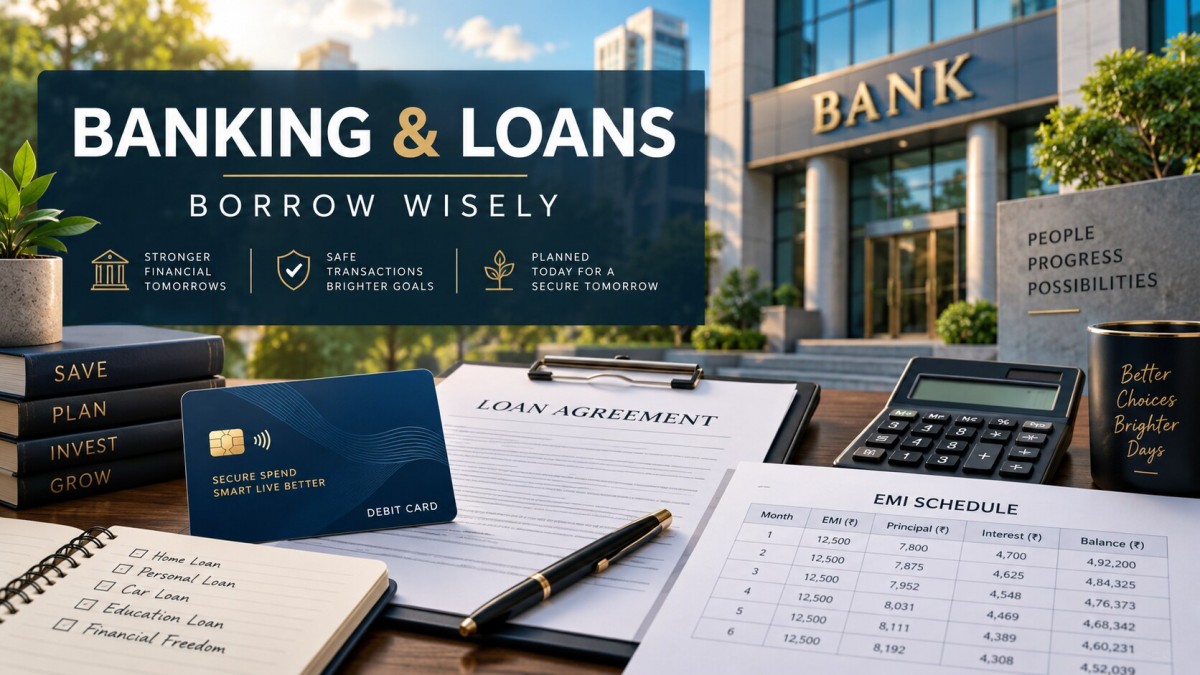

Banking and Loans: A Beginner’s Guide to Borrowing Wisely

Learn how banking services and loans work, including account types, interest rates, EMIs, secured and unsecured loans, eligibility, charges, repayment, and essential safety tips for borrowers.

Sep 06, 2026 - 19:27
0 0
Banking and Loans: A Beginner’s Guide to Borrowing Wisely

Banking and Loans: A Beginner’s Guide to Borrowing Wisely

Banks play an important role in our everyday financial lives. They help us keep money safely, receive payments, transfer funds, build savings, make digital transactions, and borrow money for important needs.

A loan can make it possible to buy a home, pay for education, expand a business, or manage a necessary expense. However, borrowing also creates a financial responsibility that may continue for months or years.

Before taking any loan, it is important to understand how much you are borrowing, how much it will actually cost, and whether you can comfortably repay it.

This guide explains the basics of banking and loans in simple language so that beginners can make more informed financial decisions.

What Is Banking?

Banking refers to the financial services provided by banks and other authorised institutions.

These services may include:

  • Accepting deposits

  • Providing savings and current accounts

  • Transferring money

  • Issuing debit and credit cards

  • Offering internet and mobile banking

  • Providing fixed and recurring deposits

  • Giving loans

  • Supporting businesses with payment and credit services

Banks connect people who save money with individuals and businesses that need funds. Depositors may earn interest on certain accounts, while borrowers generally pay interest on loans.

Common Banking Services

Modern banks offer much more than a place to deposit cash.

Savings Accounts

A savings account allows individuals to deposit money, receive payments, make transactions, and withdraw funds when required.

Depending on the bank and account type, it may provide:

  • Interest on the balance

  • Debit-card access

  • Mobile and internet banking

  • UPI services

  • ATM withdrawals

  • Automatic bill payments

Customers should check minimum-balance conditions, transaction limits, service charges, and other account terms.

Current Accounts

Current accounts are generally designed for businesses, firms, professionals, and organisations that make frequent transactions.

They may offer higher transaction limits and business-related banking facilities. However, they may have different balance requirements and charges compared with savings accounts.

Fixed Deposits

A fixed deposit allows money to be deposited for a selected period at an agreed interest rate.

Before opening a fixed deposit, check:

  • Deposit period

  • Interest rate

  • Premature withdrawal conditions

  • Applicable penalties

  • Renewal instructions

  • Tax implications

Do not choose a deposit only because it advertises a higher interest rate. Verify the institution and understand the terms.

Recurring Deposits

A recurring deposit allows customers to deposit a fixed amount regularly for a chosen period.

It may be useful for people who want to build savings through regular monthly contributions.

Digital Banking

Digital banking allows customers to access banking services through mobile applications, websites, UPI, cards, and other electronic channels.

It provides convenience, but customers must use these services carefully.

Never share your:

  • OTP

  • ATM PIN

  • UPI PIN

  • Card CVV

  • Internet-banking password

  • Mobile-banking login details

A genuine bank representative should not ask you to disclose confidential passwords or PINs.

Different Types of Bank Accounts

Choosing the correct bank account depends on how you plan to use it.

Regular Savings Account

Suitable for individuals who want to save money and perform everyday transactions.

Salary Account

Usually opened through an employer for receiving salary. Its benefits and balance conditions may change if salary credits stop, so customers should understand the bank’s terms.

Basic Savings Account

Designed to provide essential banking facilities with simpler balance requirements. Features and transaction conditions depend on the account and institution.

Joint Account

A joint account is held by two or more people. Account holders should understand who can operate it and what happens in the event of death or incapacity.

Minor Account

A minor account is opened for a child and is generally operated according to the bank’s rules regarding age and guardianship.

NRE and NRO Accounts

These accounts are intended for eligible non-resident Indians. Their purposes, tax treatment, deposit rules, and repatriation conditions are different.

Customers should obtain current information before opening or using such accounts.

What Is a Loan?

A loan is money borrowed from a bank or another lender under an agreement to repay it over a specified period.

The borrower generally repays:

  1. The original amount borrowed, known as the principal

  2. The cost of borrowing, known as interest

  3. Any disclosed fees or charges that apply

Loan repayments may be made through monthly instalments or another agreed schedule.

A loan should not be judged only by the amount available or the monthly EMI. The borrower must understand the complete cost and all major conditions.

Important Loan Terms

Principal

The principal is the original amount borrowed from the lender.

Interest Rate

The interest rate is the percentage charged by the lender for providing the loan.

A lower advertised interest rate does not always mean a cheaper loan. Processing fees, insurance, documentation costs, taxes, and other charges may affect the total cost.

Loan Tenure

The tenure is the period provided for repayment.

A longer tenure may reduce the monthly EMI but can increase the total interest paid. A shorter tenure may reduce the total interest but require a higher EMI.

EMI

EMI stands for Equated Monthly Instalment.

It usually contains:

  • A portion of the principal

  • A portion of the interest

The balance between principal and interest changes over the loan period according to the repayment structure.

Annual Percentage Rate

The Annual Percentage Rate or APR represents the annual cost of credit based on the applicable methodology. It can provide a broader view of borrowing costs than the interest rate alone because certain charges may be included.

Use the lender’s official Key Facts Statement and loan documents to understand exactly how the APR has been calculated.

Processing Fee

A processing fee may be charged for evaluating and processing the loan application. Check whether it is refundable and whether applicable taxes are added.

Collateral

Collateral is an asset offered as security for a loan.

For example, a property may serve as security for a home loan. If the borrower does not repay according to the agreement, the lender may have legal rights over the secured asset.

Credit Score and Credit History

A credit score is based on information in a person’s credit report. Lenders may use it along with income, existing obligations, repayment history, and other factors while evaluating a loan application.

A high credit score does not guarantee approval, and a lower score does not automatically mean every application will be rejected.

Secured and Unsecured Loans

Loans are commonly divided into secured and unsecured categories.

Secured Loans

A secured loan is supported by an asset or collateral.

Common examples may include:

  • Home loan

  • Loan against property

  • Vehicle loan

  • Gold loan

  • Loan against certain deposits or securities

Secured loans may offer different interest rates because the lender has security against the amount borrowed. However, failure to repay can put the secured asset at risk.

Unsecured Loans

An unsecured loan does not usually require a specific asset as collateral.

Examples may include:

  • Personal loan

  • Certain education loans

  • Consumer loan

  • Credit-card borrowing

Approval may depend heavily on income, credit history, employment or business stability, existing debt, and the lender’s assessment.

Unsecured loans may carry higher borrowing costs than secured loans.

Common Types of Loans

Personal Loan

A personal loan may be used for various personal expenses, subject to the loan agreement.

It is often unsecured and may have a higher interest rate than some secured loans. Before applying, compare the APR, total repayment, fees, late-payment charges, and prepayment conditions.

Home Loan

A home loan is generally used to purchase, construct, or renovate residential property.

Because the amount and tenure can be significant, borrowers should consider:

  • Down payment

  • EMI affordability

  • Fixed or floating interest rate

  • Total interest cost

  • Legal verification of the property

  • Insurance requirements

  • Prepayment conditions

  • Effect of an interest-rate increase

Vehicle Loan

A vehicle loan helps finance the purchase of a car or another eligible vehicle.

Compare the loan cost with the vehicle’s value, down payment, insurance, registration, maintenance, and depreciation.

Education Loan

An education loan may help pay eligible education-related expenses.

Borrowers should understand the moratorium, repayment start date, interest during the study period, collateral requirements, co-borrower obligations, and employment uncertainty after completing the course.

Business Loan

Business loans may be used for inventory, machinery, working capital, expansion, or other business needs.

Business owners should estimate whether expected cash flow can support repayment even during slower months.

Gold Loan

A gold loan is secured against eligible gold ornaments or other accepted gold assets.

Customers should check valuation, interest, repayment method, charges, auction-related conditions, and the process for returning the pledged gold after repayment.

Loan Against Property

This loan uses property as security.

Although it may provide access to a larger amount, failure to repay can put the property at risk. The purpose of borrowing and repayment capacity should be evaluated carefully.

Fixed and Floating Interest Rates

Fixed Interest Rate

Under a fixed-rate structure, the applicable interest rate is intended to remain fixed according to the loan agreement.

However, borrowers should read the terms carefully because the meaning of “fixed” may depend on the specific product and contract.

Floating Interest Rate

A floating rate may change based on the lender’s benchmark and agreed reset conditions.

When the rate changes, it may affect:

  • EMI amount

  • Loan tenure

  • Total interest payable

  • A combination of EMI and tenure

Before accepting a floating-rate loan, understand the benchmark, spread, reset frequency, and options available if rates change.

How to Compare Loans

Do not select a loan only because it offers the lowest EMI.

Compare the following:

  • Loan amount

  • Interest rate

  • APR

  • Total repayment amount

  • Loan tenure

  • Processing fee

  • Insurance cost

  • Documentation charges

  • Late-payment charges

  • Penal charges

  • Prepayment or foreclosure conditions

  • Collateral requirements

  • Fixed or floating rate

  • Customer-service and complaint process

Ask the lender for the Key Facts Statement, where applicable. Read it before accepting the loan.

Do not sign blank forms or agree to terms that you have not understood.

How Much EMI Can You Afford?

A lender approving a loan does not automatically mean the EMI is comfortable for your budget.

Before borrowing, calculate your:

  • Monthly take-home income

  • Essential household expenses

  • Existing EMIs

  • Insurance premiums

  • Regular savings

  • Emergency-fund needs

  • Irregular but necessary expenses

Leave enough room for unexpected costs and possible income changes.

Avoid choosing an EMI that requires you to depend on credit cards or new loans for ordinary household expenses.

Steps to Take Before Applying for a Loan

Step 1: Identify the Purpose

Be clear about why you need the loan. Avoid borrowing for unnecessary purchases simply because credit is easily available.

Step 2: Calculate the Required Amount

Borrow only what you genuinely need and can reasonably repay.

Step 3: Check Your Budget

Calculate whether the EMI fits comfortably after essential expenses, existing obligations, savings, and insurance.

Step 4: Compare Multiple Lenders

Compare official offers from banks and regulated financial institutions. Do not depend only on advertisements or verbal promises.

Step 5: Read the Key Facts Statement

Review the interest rate, APR, EMI, tenure, fees, penal charges, and total repayment.

Step 6: Understand Fixed and Floating Rates

Know whether your repayment may change if the benchmark interest rate changes.

Step 7: Verify the Lender and Loan Application

Use official banking websites and verified applications. Be careful with unknown loan apps, social-media advertisements, and agents requesting money in personal accounts.

Step 8: Keep Copies of All Documents

Retain the application, KFS, sanction letter, repayment schedule, receipts, account statements, and important communication.

Common Loan Mistakes to Avoid

Borrowers should avoid these common mistakes:

  • Focusing only on the EMI

  • Ignoring the total repayment amount

  • Choosing an unnecessarily long tenure

  • Applying for several loans at the same time

  • Taking a loan without checking repayment capacity

  • Borrowing to repay another loan without a proper plan

  • Missing EMI due dates

  • Ignoring processing and insurance costs

  • Signing documents without reading them

  • Trusting verbal promises that are absent from the agreement

  • Using an unverified digital-loan application

  • Sharing OTPs, PINs, or banking passwords

  • Paying an agent through an unknown personal account

  • Borrowing for speculative trading or guaranteed-return schemes

Digital Banking and Loan Safety

Fraudsters may pretend to be bank employees, loan agents, customer-care representatives, or government officials.

Follow these safety practices:

  • Download banking applications only from official sources

  • Verify website addresses carefully

  • Never share an OTP, PIN, password, or CVV

  • Do not install unknown screen-sharing applications

  • Avoid clicking suspicious loan or KYC links

  • Do not make advance payments based only on a phone call

  • Check account alerts regularly

  • Report unauthorised transactions immediately

  • Keep your registered mobile number and email updated

  • Use strong and unique passwords

If you notice an unauthorised banking transaction, inform the bank immediately. Delayed reporting may affect your rights and potential liability under applicable rules.

What to Do If You Have a Banking Complaint

First, submit a written complaint through the bank or lender’s official complaint channel. Keep the complaint number and copies of supporting documents.

If the regulated entity does not resolve the complaint satisfactorily or does not respond within the applicable period, eligible complaints may be submitted through the Reserve Bank–Integrated Ombudsman Scheme.

Use only the official RBI Complaint Management System and check the current eligibility and procedure before filing.

Frequently Asked Questions

Is a Lower EMI Always Better?

No. A lower EMI may result from a longer tenure, which can increase the total interest paid.

Compare the total repayment and APR, not only the monthly instalment.

What Is the Difference Between Interest Rate and APR?

The interest rate is the rate charged on the borrowed amount. APR is intended to provide a broader annualised view of the loan’s cost based on the applicable method and included charges.

Check the lender’s KFS for the exact calculation.

Can a Loan Be Repaid Early?

Some loans may allow part-payment or foreclosure. Charges and conditions depend on the product, rate type, lender, borrower category, and applicable rules.

Read the agreement before making a decision.

Does Checking a Loan Offer Affect My Credit Score?

Simply viewing general information may not affect your score. However, a formal application may result in a lender accessing your credit report.

Multiple applications within a short period may be considered during credit evaluation.

Should I Take a Loan From a Mobile Application?

Use a digital loan application only after verifying the regulated lender behind it, the official website, permissions requested, total cost, repayment terms, privacy practices, and complaint channels.

Do not use an application only because it promises instant approval.

Final Thoughts

Banking services can make it easier to save, transfer money, make payments, and work toward financial goals. Loans can also be useful when they finance a genuine need and the repayment is carefully planned.

However, a loan is not additional income. It is money that must be repaid along with interest and applicable charges.

Before borrowing:

  • Understand your financial need

  • Calculate your repayment capacity

  • Compare the complete cost

  • Read all official documents

  • Verify the lender

  • Protect your banking information

  • Pay every instalment on time

The best loan is not necessarily the one that offers the largest amount. It is the one you understand and can repay comfortably without damaging your financial stability.


Disclaimer: This article is for general educational purposes only. It does not constitute banking, credit, legal, tax, or financial advice. Interest rates, fees, regulations, eligibility, and loan conditions may change. Check current official documents and consult a qualified professional when required.

What's Your Reaction?

Like Like 0
Dislike Dislike 0
Love Love 0
Funny Funny 0
Wow Wow 0
Sad Sad 0
Angry Angry 0

Comments (0)

User