

The Power of Compounding: How to Grow Your Wealth Over Time
Understand the magic of compound interest and how starting early can significantly boost your long-term investment portfolio and wealth.
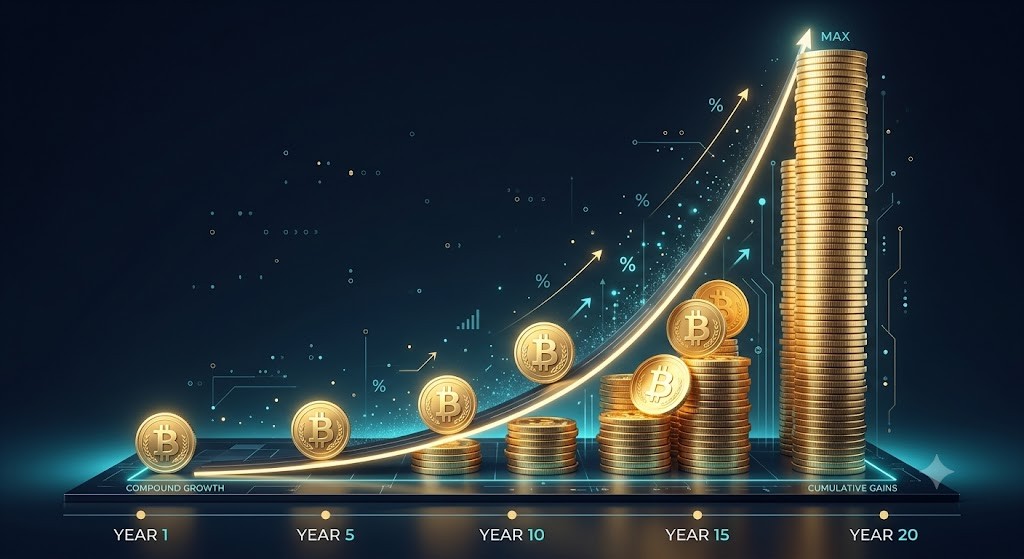
The concept of compounding is arguably the most powerful force in finance. While earning money through active income is essential, compound interest allows your money to work for you passively. In this comprehensive guide, we will explore the profound mechanics of compound interest, why time is your greatest asset, and how you can strategically harness this financial phenomenon to build substantial, generational wealth.

1. The Magic Unveiled: What Exactly is Compound Interest?
At its core, compound interest is the interest you earn not only on your initial investment (the principal) but also on the accumulated interest from previous periods. Think of it as 'interest on your interest.' Contrast this with simple interest, which only pays out based on the original deposit. The magic of compounding lies in its exponential growth curve. Over time, this creates a 'snowball effect.' As a snowball rolls down a hill, it gathers more snow not just from its original core, but from the massive new surface area it has already built. This is exactly how your wealth grows over decades.
2. The Cost of Delay: Why Starting Early is Critical
In the math of compounding, time is vastly more important than the actual amount of money you invest. The earlier you begin, the more compounding cycles your money experiences. Consider two investors: Investor A starts investing $300 a month at age 25 and stops at 35 (investing for just 10 years). Investor B starts at age 35 and invests $300 a month until age 65 (investing for 30 years). Assuming a standard 8% annual return, Investor A will end up with significantly more wealth by age 65, despite having invested far less out-of-pocket capital. This perfectly illustrates the enormous, hidden cost of waiting 'until you have more money' to start investing.
3. The Three Pillars of Compound Growth
To maximize your wealth trajectory, you must optimize three core variables:
- Time (The Horizon): As demonstrated, leaving your money untouched for decades is the secret ingredient.
- Rate of Return (The Yield): Even a 1% or 2% difference in your annual return can mean a difference of hundreds of thousands of dollars over a 30-year period.
- Frequency of Compounding: Money that compounds daily or monthly will grow faster than money that compounds annually.

4. Strategic Vehicles for Compound Wealth
You cannot simply leave your money in a traditional checking account and expect it to compound effectively against inflation. You need the right financial vehicles:
- Broad-Market Index Funds and ETFs: These provide diversified exposure to the stock market, historically offering reliable long-term compounding returns.
- Dividend Growth Stocks: Investing in companies that pay and consistently increase their dividends provides a dual-engine of growth: capital appreciation and dividend reinvestment.
- Retirement Accounts: Utilizing tax-advantaged accounts ensures that annual taxes do not eat into your compounding returns year after year.
5. Actionable Steps for Effective Compounding
The theory is simple, but the execution requires immense psychological discipline.
- Automate Your Investments: Set up automatic transfers from your checking account to your brokerage account the day after you get paid. This removes emotion and ensures consistency.
- Always Reinvest Dividends: Never withdraw your dividend payouts during your wealth-building phase. Reinvesting them automatically buys more shares, which in turn generate more dividends.
- Stay the Course: The stock market will experience crashes, corrections, and bear markets. Interrupting the compounding process by panic-selling destroys the exponential growth curve.
Conclusion: The Ultimate Test of Patience
Building wealth through compound interest is not a get-rich-quick scheme; it is a get-rich-slowly certainty. By understanding the mechanics of 'interest on interest,' starting as early as possible, optimizing your rate of return, and strictly reinvesting your earnings, anyone can harness this mathematical marvel to achieve absolute financial independence. The best time to start was ten years ago; the second-best time is today.
What's Your Reaction?
 Like
0
Like
0
 Dislike
0
Dislike
0
 Love
0
Love
0
 Funny
0
Funny
0
 Wow
0
Wow
0
 Sad
0
Sad
0
 Angry
0
Angry
0

Software developer with expertise in full-stack web development and financial market analysis, specializing in building tracking tools for trading metrics.









Comments (0)